Why is my Shopify store getting no sales?
Most Shopify stores fail not because of bad products, but because Shopify gives you a store, not an audience. Without existing traffic, a marketing budget, or a built-in community, your store sits invisible. The sellers who do make consistent income online are usually using platforms where finding customers, running ads, and creating content are built in, not problems they have to solve before the store can work.
You spent weeks on it. You chose the niche, picked the theme, wrote the product descriptions, set up Stripe, obsessed over the logo. Then you hit publish, shared it everywhere you could think of, and then… nothing. A Shopify store with no sales, no traffic, and no idea what went wrong. Maybe one abandoned cart that kept your hopes alive for a day.
If this sounds familiar, you are not alone, and you are definitely not bad at business. In fact, scroll through any entrepreneurship subreddit and you’ll find thousands of posts from people asking the same desperate question: why is my Shopify store not selling? The answers they get are usually surface-level. The real answer is a little more uncomfortable.
This is the post I wish had existed before I went through it.
The SetupThe Dream They Sell You
Shopify’s marketing is genuinely brilliant. The ads, the success stories, the “I make $40K a month from my laptop” YouTube thumbnails: all of it points to one idea: set up a store, and the money follows. The platform itself is polished and relatively easy to use. You can have something that looks professional up in a weekend.
That ease is real. However, the implication that follows (that ease equals income) is not.
Source: Reddit
The platform does exactly what it promises: it hosts your store, processes payments, and manages your inventory. What it never promised, but what most people assume, is customers. That part was always your problem to solve. That said, the gap between what Shopify offers and what most beginners need is where things go wrong.
The RealityWhat Nobody Tells You Before You Sign Up
Here are the things buried in fine print, YouTube comment sections, and Reddit threads that the onboarding flow never mentions:
💡 Shopify is an infrastructure company, not a marketing company. It gives you the pipes. You still have to find the water (traffic, attention, and trust) entirely on your own.
First, there is no built-in discovery. Unlike Etsy, Amazon, or even Gumroad’s marketplace, Shopify has no internal search where buyers browse. When someone lands on your Shopify store, it’s because they already knew to look for you. That means you need to create that awareness from scratch, every single day.
On top of that, SEO takes months, minimum. Every new Shopify store starts with zero domain authority. Even if you do everything right: keyword research, product page copy, blog posts, you are typically 6 to 12 months away from meaningful organic traffic. Most people quit long before that.
Why Paid Ads Don’t Fix the Problem
⚠️ Paid ads are not a shortcut for beginners. Running Facebook or Google ads without a proven offer, optimized conversion rate, and money to lose while testing is one of the fastest ways to spend your savings and still get zero sales. The ad platforms take your money whether the campaign works or not.
And even when ads do work, they stop working the moment you stop paying. There’s no retention built into Shopify. Every customer you acquire through paid traffic is a one-time transaction unless you do the extra work of capturing their email and bringing them back manually. Most beginners don’t. So they keep paying to acquire the same customer over and over, and the margin never improves.
The average Shopify conversion rate is 1–2%. That means even if you somehow drive 500 visitors to your store (which is genuinely hard) you might get 5 to 10 sales. If your margin is $20 per sale, that’s $100–$200. As a result, after platform fees, payment processing, and whatever you spent getting those visitors there, you’re often in the red. And abandoned carts don’t help either. The average ecommerce cart abandonment rate sits around 70%, meaning most people who do show up leave without buying anyway.

The Real Reasons Your Shopify Store Isn’t Selling
Let’s be specific. When people post “Shopify store no traffic, no sales, help” in forums, the root causes almost always fall into a few categories:
🚫 You have no existing audience
The most common reason for Shopify dropshipping no sales, and the one nobody wants to say out loudThe Shopify stores that actually work belong to people who already had something: an Instagram following, a YouTube channel, a newsletter, a TikTok, a Facebook group. They didn’t build an audience by opening a store. They opened a store because they already had an audience to sell to. If you’re starting from zero followers, you’re not opening a store. You’re building a brand from scratch, which is a fundamentally different (and much harder) thing.
🚫 You’re in an oversaturated niche with no differentiation
Especially common in dropshipping and print-on-demandIf your store sells generic products that a buyer could find on Amazon with faster shipping and an easier return policy, price isn’t going to save you. The stores that break through have either a genuinely unique product, a story that resonates, or an existing relationship with the people buying from them. A brand-new store with no reviews and no social proof rarely wins on product quality alone.
When the Numbers Simply Aren’t There
🚫 Your traffic is near zero and you have no plan to change that
This is where most people get stuck longestIf you’re getting under 50 visitors a week, your conversion rate is almost irrelevant. There’s simply not enough volume for anything meaningful to happen. Traffic generation is a full-time job in itself: SEO, content marketing, paid social, influencer partnerships, email list building. Most people building a Shopify store on the side don’t have the time or budget to do any of these at the level required.
🚫 The product-market fit isn’t there yet
Hard to hear, but worth considering honestlySometimes the issue isn’t the platform or the marketing. It’s that the product doesn’t solve a strong enough problem, or the pricing is off, or the target customer is too vague. A Shopify store doesn’t validate your idea. It just makes it easier to find out the hard way that the idea needs more work.
The Math That Gets Quietly Ignored
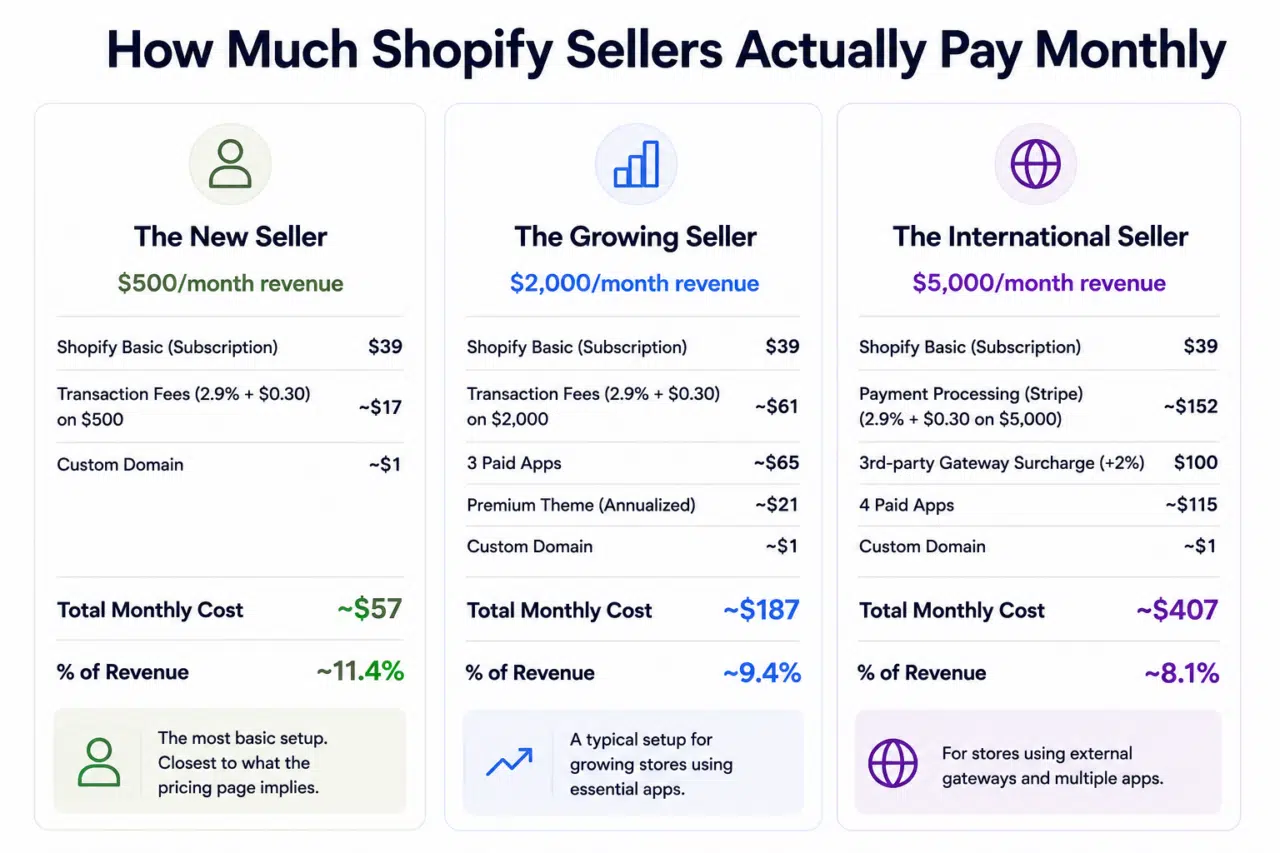
Before you pour more time into your store, it’s worth doing the math that the “passive income” content creators never show you. A lot of sellers only realize Shopify fees are too high once they’re already several months and hundreds of dollars in:
| Cost / Variable | Typical Range | What People Expect |
|---|---|---|
| Shopify plan (Basic) | $39/month | “It’ll pay for itself fast” |
| Paid apps (email, reviews, upsells) | $30–$150/month | Often forgotten entirely |
| Transaction fees (non-Shopify Payments) | 0.5–2% per sale | Assumed to be zero |
| Paid ads to get traffic | $300–$1,000+/month | “I’ll start small” |
| Time to first meaningful revenue | 6–18 months | “A few weeks” |
| Avg. store conversion rate | 1–2% | “If I get traffic, I’ll sell” |
💡 A realistic scenario: You spend $39/month on Shopify, $60 on apps, and $400 on Facebook ads. You drive 800 visitors. At a 1.5% conversion rate with a $35 average order value, that’s 12 sales and $420 revenue, against $499 in costs. Month one: you’re down $79. Month two looks similar. This is why so many stores are abandoned quietly, with no fanfare.
Want the full fee-by-fee breakdown covering transaction costs, app stack, hidden extras, and real-world scenarios? We’ve done the math in detail: How Much Does Shopify Really Cost Per Month?
A Fair Take: When Shopify Actually Makes Sense
This wouldn’t be an honest post if it didn’t acknowledge what Shopify genuinely does well. So is Shopify worth it for beginners? The honest answer is: it depends entirely on what you’re selling and whether you already have the infrastructure to drive traffic. There are real scenarios where it’s the right tool:
💡 Shopify is excellent if you’re selling physical products at scale, have the budget for paid acquisition, need serious inventory management, or are running a brand with multiple SKUs and fulfillment complexity. It’s built for proper, full-scale ecommerce. The problem is it gets marketed to creators and solopreneurs who don’t have those foundations yet.
If you already have strong supplier relationships, existing wholesale accounts, or you’re transitioning a brick-and-mortar business online, Shopify makes a lot of sense. The same goes if you have a marketing team or are working with an agency and have a real ad budget.
But if you’re a solo seller, a side hustler, or someone just starting out without a team or a marketing budget: Shopify is almost certainly the wrong tool. You don’t need a store engine that assumes you’ve already solved the traffic problem. You need a platform where the selling infrastructure is built in from day one.
The AlternativeThe Best Shopify Alternative for Small Sellers and Solo Entrepreneurs
The core problem with Shopify isn’t the platform itself. It’s that Shopify hands you a store and leaves the hardest part (finding customers) entirely up to you. Nas.com is built around the opposite idea: the AI does the selling work so you don’t have to figure it out alone.
Snap one photo of your product. Nas.com’s AI builds your storefront, generates studio-quality product images, writes your copy, creates ad creatives, and launches your Meta campaigns in three clicks. No pixel setup. No Business Manager maze. No separate app stack — and no waiting months for SEO to kick in.
It’s an AI ecommerce platform built from the ground up for solo sellers who want to start selling without a team, a designer, or a marketing budget. Over 350,000 people are already working for themselves on it. The question Nas.com starts from isn’t “how do we host your store?” It’s “how do we get you your first sale?”
Shopify vs. Nas.com: What You’re Actually Paying
| Feature | Shopify Basic ($39/mo) | Nas.com |
|---|---|---|
| Monthly fee | $39 | From $9/month (free trial available) |
| Transaction fees | 0.5–2% + payment processing | 0% + payment processing |
| AI storefront builder | ❌ Not included | ✅ Built-in |
| AI product photography | ❌ Not included | ✅ Built-in |
| AI ad creatives | ❌ Needs paid app | ✅ Built-in |
| One-click Meta ad campaigns | ❌ Manual setup required | ✅ Built-in |
| Email & outreach tools | ❌ Needs paid app | ✅ Built-in |
| You own your customer list | ✅ | ✅ |
For a full breakdown of how Nas.com stacks up against other platforms, see our comparison guides: Nas.com vs. Shopify and Nas.com vs. Etsy.
Platform FeaturesWhat You Get With Nas.com That Shopify Can’t Replicate
AI Storefront Builder
Upload one photo. The AI builds your entire store, writes product descriptions, and sets your brand identity in minutes.
AI Product Photography
Studio-quality product photos generated by AI. No photoshoot, no designer, no Canva subscription needed.
One-Click Meta Ads
Launch Facebook and Instagram campaigns in three clicks. No pixel setup, no Business Manager, no guesswork.
AI Ad Creatives
Type a prompt, get professional ad creatives ready to run on Meta, Instagram, and social. No designer required.
Magic Reach
Reach your customers via email and outreach tools built right in. Your list, your data, no middleware.
Simple, Transparent Pricing
No surprise app bills, no escalating fees as you grow. See the full pricing breakdown.
Why Solo Sellers Are Switching to Nas.com

Verdict
The honest summary
Shopify is not a bad platform. Instead, it’s a mismatched one for most of the people who sign up for it. It was built for retail and ecommerce brands with real marketing budgets and supply chains, not for individual creators trying to monetize their expertise, content, or community.
If your Shopify store has no sales, the most likely explanation isn’t that you chose the wrong theme or wrote bad product descriptions. It’s that you were handed a store and left to figure out everything else (the traffic, the ads, the content, the customers) entirely on your own.
The sellers who actually make consistent income online aren’t necessarily smarter or more talented. They’re using tools where finding customers, creating content, and running ads are built into the platform, not separate problems to solve before the store can work.
That’s what Nas.com is. Snap a photo, and the AI builds your store, generates your product images, creates your ad creatives, and launches your campaigns. Everything in one place, from day one.
Tired of a Store That Gets Visits But No Sales?
Nas.com builds your store, creates your ads, and finds your customers. All in one place.
Start Your Free Trial on Nas.com →Frequently Asked Questions
About Shopify & Why Stores FailWhy does my Shopify store have no traffic?
Because Shopify provides zero built-in discovery. Unlike marketplaces such as Etsy or Amazon, there is no internal search engine sending buyers to your store. Every visit has to come from somewhere you’ve built yourself: social media, SEO, paid ads, email, or word of mouth. A new store with no marketing foundation will have almost no traffic by default.
How long does it take to get sales on Shopify?
It varies enormously. Stores with existing audiences or a paid ad budget can see sales within days. Stores relying on organic SEO often wait 6–12 months before meaningful traffic arrives. The honest average for a bootstrapped beginner store is 3–6 months before the first consistent sales, and many never reach that point.
Is Shopify worth it for a small creator or solopreneur?
For physical products with a real supply chain, potentially yes. For digital products, courses, memberships, or community monetization: probably not. Shopify’s tooling for those creator use cases requires multiple paid apps, and the traffic problem remains. Platforms built specifically for creators typically result in faster revenue with less overhead.
Can I get sales on Shopify without paid ads?
Yes, but it requires consistent organic effort over months: SEO-optimised content, social media presence, email list building, and ideally some form of existing audience. It’s not impossible, but it’s slow, and for most first-time store owners, the time and energy investment is higher than expected.
What is a good Shopify conversion rate?
The industry average sits between 1–2%. Top-performing Shopify stores with optimised product pages, trust signals, and strong brand recognition can reach 3–4%. If you’re below 1%, it’s often a trust or product-fit issue, not just a traffic problem.
My Shopify store has visitors but no sales. What’s wrong?
Visitors without sales usually means one of three things: the traffic isn’t the right fit for your product, your store lacks trust signals (reviews, clear return policy, professional photos), or there’s friction at checkout. But for new stores, the most common cause is simply that the traffic volume is too low to generate statistically meaningful sales. Under 500 visitors a month, even a good store will look like it’s failing.
Why is my Shopify store not making money despite having products listed?
Having products listed is just the starting point. Without active traffic generation (SEO, paid ads, social media, or an existing audience), most Shopify stores sit invisible. The platform doesn’t surface your products to buyers. That’s entirely your responsibility to solve outside of Shopify.
Are Shopify fees too high for beginners?
For beginners who aren’t yet generating revenue, yes, the costs stack up quickly. The Basic plan at $39/month, plus apps, payment processing, and any ad spend can easily push your monthly overhead past $300–$500 before you’ve made a single sale. For a full breakdown, read How Much Does Shopify Really Cost Per Month?
How do I deal with abandoned carts on Shopify with no sales?
Abandoned carts are normal. Around 70% of all ecommerce carts get abandoned. For Shopify stores, the most common fixes are: automated recovery emails, removing surprise costs at checkout (especially shipping), offering a guest checkout option, and adding trust signals near the buy button. That said, if your overall traffic is very low, fixing cart abandonment won’t move the needle much until you solve the traffic problem first.
What does Nas.com actually cost?
Nas.com starts from $9/month with a free trial available. Plans scale up with more features and lower transaction rates. See the full breakdown at nas.com/pricing.
What can I sell on Nas.com?
Pretty much anything. Physical products, digital downloads (eBooks, templates, presets, guides), online courses, paid communities, memberships, and more. Everything is built into the platform with no third-party apps required.
Do I need a big audience to use Nas.com?
No. Nas.com is built for people starting from scratch. The AI handles your store, your content, and your ads, so you don’t need an existing following to get your first sale. You just need a product and a photo.
How is Nas.com different from Shopify?
Shopify gives you a store and leaves everything else (traffic, marketing, content, ads) up to you. Nas.com is an AI ecommerce platform that handles the selling work too: it builds your store from a photo, generates product images, creates ad creatives, and launches Meta campaigns in three clicks. For a detailed side-by-side, read our Nas.com vs. Shopify comparison.