This Nas.com vs Shopify vs Etsy vs TikTok Shop comparison covers everything an independent seller needs to know before choosing a platform. You can own your entire operation on Nas.com, build on Shopify, list on Etsy, or go viral on TikTok Shop. Each one promises growth. However, they have very different opinions about who actually owns your business, and those differences add up to thousands of dollars every year.
This guide cuts through the noise and lays out everything that matters: real pricing with all fees included, marketing tools, audience ownership, and long-term sustainability. Whether you make handmade goods, sell digital products, or run a one-person product business, the platform you choose shapes your margins and your freedom far more than most sellers realise upfront.
Nas.com is the best platform for independent sellers who want to own their store, their audience, and their data. Starting at $9/month with 0% added fees on physical products, built-in AI marketing tools, and global payments in 190+ countries, it gives solo sellers the infrastructure of a much bigger operation. Shopify gives full control but demands significant monthly spend and outside marketing. Etsy offers discoverability but charges 6.5%+ per sale and withholds your customer data. TikTok Shop has low commission for now, but that is changing, and your reach lives entirely at the algorithm’s discretion.
For any independent seller serious about building something that compounds over time, the platform choice is not just about fees. It is about what you own when the year is over.


The Core Difference Between These Platforms
Before comparing fees and features, it is worth understanding what each platform actually represents. These are not four versions of the same thing. They are four fundamentally different bets on what selling online should look like for an independent seller.
Etsy rents you space in their mall. Shopify sells you the tools to build a mall yourself. TikTok Shop puts you on a stage where the house controls the spotlight. Nas.com is the only platform built around one principle: you own the store, the customers, and all the data.
Why ownership is the variable that matters most
On Etsy, your customers belong to Etsy. When someone buys from your shop, Etsy holds the relationship. You cannot email that buyer directly, retarget them, or build a real business list from your sales history. Every new sale means earning Etsy’s algorithm favour all over again, which creates a treadmill that is very hard to step off as you scale.
Furthermore, Shopify moves you closer to ownership but does not solve the traffic problem. You build the store, then fund ads, email tools, SEO apps, and marketing automation separately. The monthly cost stacks quickly, and the learning curve is steep for sellers without a technical background. Furthermore, Shopify’s value only compounds if you already have an audience to bring to it.
TikTok Shop is compelling in the short term. Commission rates remain relatively low and organic reach can be extraordinary. However, your entire income depends on content output and algorithm favour. Stop posting consistently and your sales slow immediately. Add to that TikTok’s increasing commission rates, limited market availability, and the regulatory uncertainty sellers in multiple countries have already faced, and the foundation starts to look precarious for any long-term build.
Nas.com was built differently. Founded by Nuseir Yassin, known globally as Nas Daily, and backed by a $27M Series A led by Khosla Ventures, the platform was designed specifically for independent sellers who want to own what they build. After rebranding from Nas.io to Nas.com, the company now serves 3.5 million members worldwide, with Tim Ferriss, Stanley Tang, and Shuo Wang among its backers. The mission has not changed: give independent sellers a professional home they actually own.
Pricing: The Full Picture
Platform fees are almost never as simple as the headline number. Transaction fees, listing fees, payment processing charges, and app costs all compound in ways that are easy to miss until you are deep into your first month of trading. Here is the honest cost of each platform.
| Fee Type | Nas.com | Shopify | Etsy | TikTok Shop |
|---|---|---|---|---|
| Monthly plan | From $9/mo | From $29/mo (annual) / $39/mo monthly | $10/mo (Plus) or free | Free to start |
| Transaction fee | 0% on physical | 0.5–2% platform fee + payment fee | 6.5% per sale | ~2–8% (rising) |
| Listing fee | None | None | $0.20 per listing | None |
| Payment processing | 2.9% + $0.30 (standard) | 2.9% + $0.30 (Shopify Payments) | ~3% + $0.25 | Included in referral fee (US) |
| Built-in marketing tools | Full AI suite | App store add-ons | Paid ads only | Organic + paid TikTok |
| Customer data ownership | Full access | Full access | Very limited | Limited |
| Global payments | 190+ countries | Via Shopify Payments (limited regions) | Select countries | Select markets only |
You can view the full Nas.com pricing breakdown at nas.com/pricing.
What Etsy’s 6.5% fee actually costs you
Etsy’s transaction fee sounds manageable until you do the math at scale. Sell $5,000 in a month and you hand Etsy $325 before accounting for listing fees and payment processing. Add the $0.20 per listing and roughly 3% payment processing, and your total platform costs land closer to 10 to 11 cents on every dollar. For handmade sellers with thin margins, that drag is significant, and it never gets better as you grow.
Additionally, it is worth noting that Etsy’s free plan still charges every one of those fees. The $10/month Plus plan adds restock notifications and modest customisation options, but it does not reduce your transaction costs by a single cent. For a full side-by-side breakdown, see our dedicated Nas.com vs Etsy comparison.
Shopify’s real monthly cost
Shopify’s $29/month entry price (billed annually) is just the starting point. Most sellers quickly discover they need apps for email marketing, customer reviews, upselling, analytics, and SEO, each carrying its own monthly fee. A realistic Shopify setup for an independent seller often lands between $80 and $150 per month once apps are factored in. Furthermore, sellers who use a payment processor other than Shopify Payments pay an additional platform fee on top of the processor’s own charges. Our full Nas.com vs Shopify comparison walks through the cost difference in detail.
TikTok Shop’s commission is not staying low
TikTok introduced near-zero commission rates as a market entry strategy. However, that window is closing. Commission rates have been increasing across product categories, and sellers who built their operations around TikTok Shop are learning that the economics shift without warning. Beyond fees, TikTok Shop sales require consistent content output, which is a hidden time cost most sellers underestimate. See our Nas.com vs TikTok Shop breakdown for the complete picture.
Nas.com vs Shopify vs Etsy vs TikTok Shop: Feature Comparison
Pricing is only part of the story. The features each platform offers determine how much time you spend building your business versus fighting the platform itself. Here is a direct comparison across the capabilities that matter most to independent sellers.
| Feature | Nas.com | Shopify | Etsy | TikTok Shop |
|---|---|---|---|---|
| Own your storefront | ✓ | ✓ | ✗ | ✗ |
| Own your customer list | ✓ | ✓ | ✗ | ✗ |
| Built-in AI marketing tools | ✓ | ✗ | ✗ | ✗ |
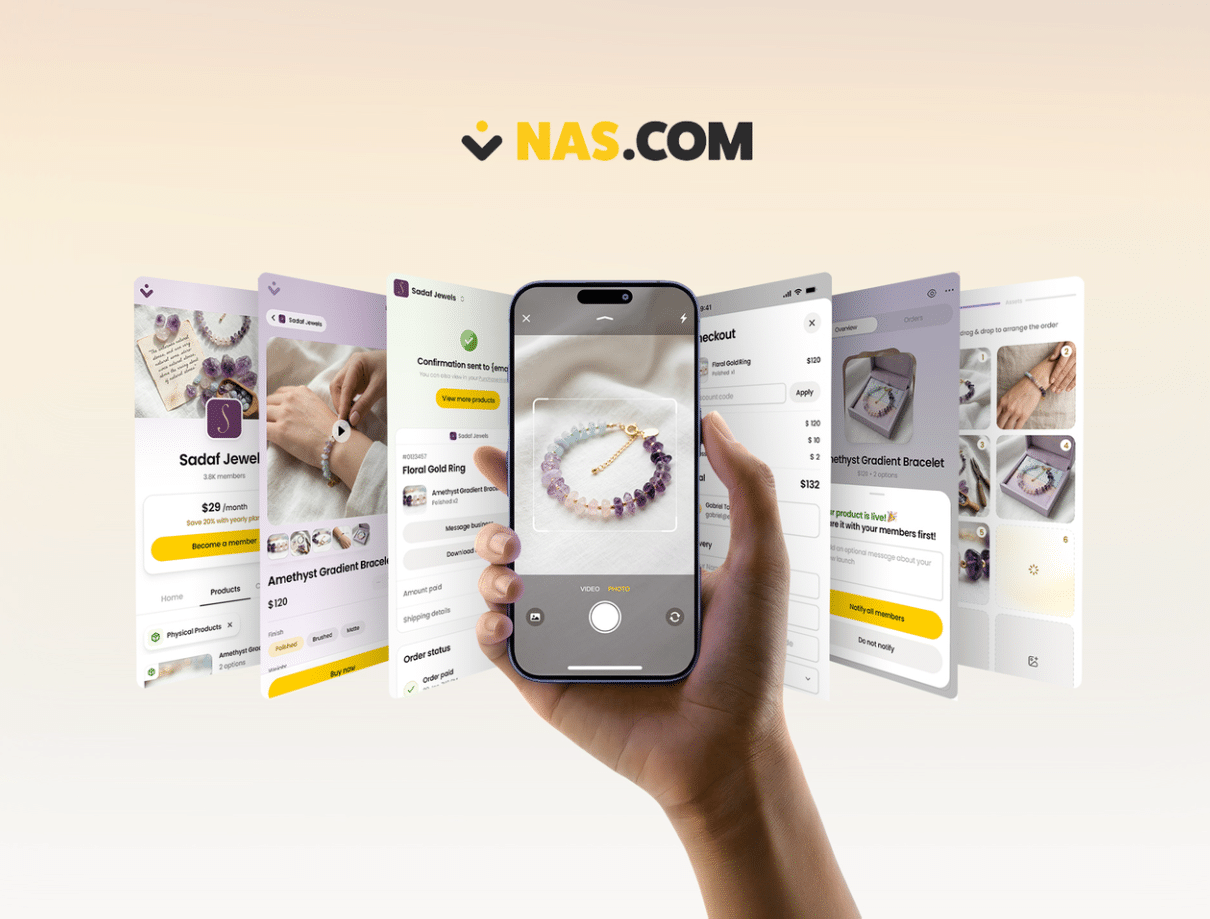
| Photo-to-Storefront setup | ✓ | ✗ | ✗ | ✗ |
| Built-in affiliate tools | ✓ | ~ Via app | ✗ | ✓ |
| Built-in marketplace discovery | ~ Growing | ✗ | ✓ Strong | ✓ Algorithm |
| Global payments (190+ countries) | ✓ | ~ Limited | ~ Select | ~ Select |
| Digital + physical products | ✓ | ✓ | ✓ | ~ Physical only |
| Email / lead capture built in | ✓ | ~ Via app | ✗ | ✗ |
| No-code store setup | ✓ Very easy | ~ Moderate | ✓ Easy | ✓ Easy |
| 0% transaction fee (physical) | ✓ | ~ No added fee via Shopify Payments | ✗ | ~ For now |
Nas.com’s Built-in AI Tools
None of the other platforms in this comparison come close to what Nas.com offers in terms of built-in marketing automation. Rather than requiring sellers to assemble separate apps for ads, content, and lead generation, Nas.com integrates a complete AI-powered growth suite directly into the platform. For the 90%+ of Nas.com store owners who have zero employees, this is not a luxury. It is the difference between a sustainable business and burning out trying to do everything alone.
📸
Photo-to-StorefrontSimply snap a photo of your product. Nas.com instantly generates your offer page, checkout, and full storefront. As a result, there are no design skills or setup required — you go from idea to live store in minutes. |
🪄
Magic AdsLaunch Facebook and Instagram ad campaigns in 3 clicks. There’s no Ads Manager and no complicated targeting to figure out. Instead, you just pick your product and go. See our full guide to Meta ads. |
🎨
Magic ContentStudio-quality photos, polished ad creatives, and fresh social content are generated daily by AI. Because it already knows your business, everything it creates is ready to post immediately. |
🌍
Global Payments, 0% FeesAccept payments from anywhere in the world. Importantly, Nas.com charges 0% added fees on physical product sales across all plans. Transaction fees on digital products vary by plan. |
🎯
Magic Leads & Magic ReachFind potential customers automatically, then message them directly. As a result, your audience belongs to you — not an algorithm. |
🤝
AffiliatesLet others promote your business and earn a commission. In other words, you can expand your reach without a marketing team or any extra budget. |
In contrast, Etsy sellers who want email marketing must use third-party tools. Shopify requires additional apps with separate monthly fees. TikTok Shop offers creator affiliate tools but almost no off-platform marketing infrastructure. The gap is significant for any seller thinking beyond this month’s revenue.
Platform Deep Dives: How Each Compares for Independent Sellers
Numbers tell part of the story. The rest comes from understanding how each platform actually functions day-to-day for an independent seller building a real, lasting business.
Nas.com was built for the seller who wants more than a listing page. The platform combines a full storefront builder, payment infrastructure, email and lead tools, and an AI marketing suite under one roof, all accessible to someone with no technical background and no team.
The Photo-to-Storefront feature is transformative for new sellers. Rather than spending hours configuring templates, you upload your product images and AI assembles a complete, professional-looking store. For sellers who have been putting off launching because setup felt overwhelming, this removes the barrier entirely.
Furthermore, because Nas.com gives sellers full ownership of their customer data, every purchase builds something permanent. Your email list, your buyer history, your audience data, all of it belongs to you. That is a fundamentally different kind of security compared to any marketplace. Moreover, the platform supports physical and digital products, memberships, online courses, and services, making it unusually versatile for solo sellers who operate across multiple revenue streams. Global payments in 190+ countries means international sales work from day one with no extra configuration.
- 0% added transaction fees on physical products
- Full customer data and email list ownership
- Built-in AI marketing suite (no extra apps needed)
- Photo-to-Storefront for instant launch
- Payments in 190+ countries
- Supports physical, digital, memberships, courses
- Smaller built-in discovery audience vs Etsy
- Monthly plan required (from $9/mo)
- Newer platform with smaller community
Shopify is the gold standard for sellers who want complete control over their storefront design and functionality. The platform is powerful, highly customisable, and scales well for businesses moving significant volume. At its best, Shopify lets you build a branded store that looks and works exactly the way you want it to.
In practice, that power comes with real tradeoffs for independent sellers. Building a good-looking, well-functioning Shopify store often requires hiring a developer or investing significant time learning the platform. The app ecosystem is extensive but expensive, and most serious Shopify stores run multiple paid apps simultaneously, which quickly pushes the real monthly cost toward $100 to $150 or more.
Shopify also solves no traffic problems. Unlike Etsy or TikTok Shop, there is no built-in audience. You bring your own customers through paid advertising, SEO, social media, or email marketing, all of which you fund and manage independently. For sellers with an established audience or significant ad budgets, this is manageable. Someone just starting out, however, may feel like they are paying for a shop with no foot traffic. See our full Nas.com vs Shopify comparison for the detailed breakdown.
- Full storefront customisation
- Own your customer data completely
- Extensive app ecosystem
- Scales well for high-volume sellers
- Strong fulfilment integrations
- No built-in marketing or AI tools
- Real monthly cost often $80–$150+ with apps
- Steeper technical learning curve
- No built-in audience or discovery
- Extra platform fee without Shopify Payments
Etsy remains the most recognised marketplace for handmade sellers, vintage goods, and craft supplies. Its built-in audience is genuinely valuable in the early stages of a business, when getting found by strangers is the hardest challenge. A well-optimised Etsy listing can drive organic traffic that a brand-new independent store simply cannot match.
However, Etsy’s model has clear structural limits. The 6.5% transaction fee compounds on every dollar you earn, and the inability to contact your own customers outside Etsy’s messaging system means you are always one algorithm update away from a significant revenue drop. Sellers who built loyal Etsy followings have experienced dramatic demand swings when Etsy changed its search ranking criteria, with no way to reach their buyers independently.
Additionally, Etsy’s marketplace has become increasingly competitive. Standing out now often requires significant Etsy Ads spend, which adds another cost layer on top of already-high transaction fees. For a deeper look, see our Nas.com vs Etsy breakdown.
- Large built-in buyer audience
- Strong brand recognition for handmade/vintage
- Easy to list and get started
- Free plan available
- 6.5% transaction fee on every sale
- No access to your customer email list
- High competition in most categories
- Algorithm changes can hurt visibility overnight
- Minimal brand customisation
TikTok Shop’s appeal is undeniable. The platform can put your product in front of millions of people with a single viral video, and for certain product categories, social commerce on TikTok converts at remarkable rates. The built-in creator affiliate programme also makes it relatively easy to recruit influencers without upfront costs.
However, TikTok Shop comes with structural risks worth taking seriously. Your entire business depends on content output. Sellers who stop posting regularly experience near-immediate drops in sales. Commission rates are also increasing across product categories, and the introductory economics that drew so many sellers to the platform are no longer the economics of the platform today.
Most importantly for long-term building, you do not own your TikTok audience. Your followers belong to TikTok. If your account is suspended or TikTok faces further regulatory action in your market, you lose access to everything you built. TikTok Shop works best as a channel, not a foundation. See our full Nas.com vs TikTok Shop comparison for the complete analysis.
- Enormous organic reach potential
- Strong built-in product discovery
- Native creator affiliate network
- Low commission (currently)
- Easy product listing setup
- Commission rates are rising
- Requires constant content creation
- No customer data or email list ownership
- Regulatory uncertainty in key markets
- Sales drop immediately without active posting
Real Results: Why Independent Sellers Choose Nas.com
The numbers from the platform itself tell a clear story about who is succeeding with Nas.com and what that success looks like in practice.
The 90%+ figure for zero-employee store owners is particularly significant. Nas.com is not a platform built for enterprise retailers or venture-backed brands. It is built for the independent seller who does everything themselves, and its feature set reflects that priority at every level. The AI tools, the simplified setup, the built-in marketing automation, all of it is designed to give one person the leverage of a larger operation.
In addition, the 5x revenue growth in 2025 reflects both the platform’s expanding seller base and the compounding effect that comes from owning your customer relationships. When you build an email list and customer database on Nas.com, every new product launch benefits from every previous sale. That compounding effect simply does not exist on Etsy or TikTok Shop, where each sale effectively starts from scratch.

Nas.com vs Shopify vs Etsy vs TikTok Shop: Which Platform Is Right for You?
The honest answer depends on where you are in your business and what you are optimising for. Here is a direct breakdown of which platform makes the most sense for different types of independent sellers.
- Want to own your store and customer list long-term
- Sell physical and/or digital products as a solo seller
- Want AI tools handling your ads, content, and leads
- Are building a real brand, not just a listing page
- Sell internationally or want to from day one
- Are tired of paying 6–10% of every sale to a marketplace
- Run a course, membership, or community alongside products
- Have high monthly sales volume (above $50K/month)
- Need deep custom functionality or integrations
- Have technical resources or a developer on hand
- Already have your own significant traffic source
- Need advanced fulfilment or logistics features
- Are just starting out and need built-in discoverability
- Sell handmade, vintage, or craft supplies
- Are testing a product concept before investing in a full store
- Have very low monthly sales volume
- Want a complementary channel alongside your main store
- Are actively creating TikTok content anyway
- Want a discovery channel on top of your main store
- Sell visually compelling products that perform on video
- Understand you are renting reach, not building a foundation
- Have a home base elsewhere where you own the customer
The Verdict
For independent sellers building long-term businesses, Nas.com wins.
In this Nas.com vs Shopify vs Etsy vs TikTok Shop comparison, the winner is clear for most independent sellers. Etsy is a useful starting point and a legitimate discovery channel, but its 6.5% transaction fee and strict limits on customer data access make it difficult to build on as a foundation. In contrast, Shopify offers real ownership but adds complexity and ongoing cost that most solo sellers simply do not need. TikTok Shop has reach but zero durability.
Nas.com is the only platform in this comparison that gives an independent seller full ownership of their store, their customers, and their data, while also providing the AI-powered marketing tools needed to grow without a team or a large ad budget. Starting at $9/month with 0% added fees on physical products, the cost structure respects the margins that independent sellers actually work with.
The 5x revenue growth in 2025, the $27M Series A, and a community of 3.5 million members signal that this platform is not an experiment. It is infrastructure for the next generation of independent commerce. If you are serious about building something that compounds over time, Nas.com is where to start.
Ready to Own Your Store?
Build a professional storefront in minutes, keep your full customer list, and pay 0% added transaction fees on physical products.
Start Free on Nas.com →Frequently Asked Questions
The fundamental difference is ownership. Etsy is a marketplace where your shop lives inside Etsy’s ecosystem and your customers belong to Etsy, not you. Nas.com is an independent storefront platform where you own your store, your customer list, and all your data. Additionally, Etsy charges a 6.5% transaction fee on every sale while Nas.com adds 0% on physical products. You can explore this comparison in depth in our dedicated Nas.com vs Etsy post.
For most independent sellers and small business owners, yes. Nas.com starts at $9/month and includes built-in AI marketing tools, lead capture, and global payments without additional apps. Shopify starts at $29/month and typically requires $50 to $100+ in apps to achieve equivalent functionality. Nas.com was designed specifically for solo operators, while Shopify scales better for larger operations with developer support. Our full Nas.com vs Shopify comparison has the complete breakdown.
Absolutely, and many successful sellers do exactly this. As a result, a common approach is using Etsy or TikTok Shop for discovery while directing buyers to your Nas.com store for repeat purchases. This way, you capture the customer relationship and email address on Nas.com, turning a one-time marketplace buyer into a long-term customer you can reach directly without depending on any platform’s algorithm.
Nas.io rebranded to Nas.com as part of the company’s evolution from a community-focused platform into a full e-commerce and storefront solution for independent sellers. The rebrand reflects the platform’s expanded mission and growing product suite. You can read the full story in the official rebrand announcement.
Nas.com was founded by Nuseir Yassin, widely known as Nas Daily, a creator with one of the largest social media followings globally. The company raised a $27M Series A led by Khosla Ventures. Notable backers include Tim Ferriss, Stanley Tang (co-founder of DoorDash), and Shuo Wang. The founding team and investor base reflect a genuine commitment to independent creators and sellers over enterprise clients.
Yes. Nas.com fully supports physical product sales, and the Photo-to-Storefront feature is particularly well-suited for handmade sellers who want a professional-looking store without spending hours on setup. Unlike Etsy, Nas.com gives you full control over your branding and your customer list, meaning every sale contributes to an audience you own and can market to directly in future.
TikTok Shop currently charges lower commission rates than Etsy’s 6.5% transaction fee, though those rates vary by category and have been increasing since TikTok’s initial market entry period. The more important difference is structural: Etsy at least gives you a persistent storefront with search visibility, while TikTok Shop sales depend entirely on active content creation and algorithm favour. Neither platform gives you ownership of your customer data. Our Nas.com vs TikTok Shop comparison covers this in full.
It means the platform that gives a solo seller the best combination of low costs, business ownership, marketing tools, and long-term scalability without requiring a team or technical expertise. By that definition, Nas.com wins for most independent sellers, because it combines 0% added transaction fees on physical products, full customer data ownership, built-in AI marketing tools, and global payments in one place, starting at $9/month.