Why patient acquisition needs a connected system
A clinic needs a patient acquisition engine that turns inquiries into attended appointments, not just more leads. This guide shows where AI marketing agents and routine automation fit into that system.
It needs more patients who book, show up and receive appropriate care.
That difference is where most clinic marketing breaks. This guide covers patient acquisition strategies for US medical practices, from local search to the follow-up that turns an inquiry into an appointment.
The Google Ads report says the clinic received 100 inquiries. Meanwhile, the Meta Ads dashboard says cost per lead fell. A webinar generated 200 registrations. Everyone celebrates the activity. Then the clinic looks at its calendar and revenue and asks a very different question:
Where are the patients?
A clinic always-on patient acquisition engine has three layers. First, four channels create and capture demand. Second, one connected funnel moves people from attention to treatment. Third, agents monitor and improve that entire system every day.
The order matters. Channels bring people in. The funnel converts them. Agents keep everything running and learning.
We keep hearing versions of the same problem from clinic owners. One clinic was already generating 40 to 50 leads every week through Google. Their instinct was to add Meta and get even more. Fair enough. But the more important question was sitting one level deeper: how many of those 40 to 50 leads were contacted, booked and actually walking through the door?
More marketing poured into a leaking funnel creates a bigger leak.
Part One: Four Channels for Your Patient Acquisition Engine
Every clinic will have a different channel mix based on its treatments, location and patient profile. But most growth-focused clinics should already be building across four categories: Google Ads, Meta Ads, educational webinars, and reputation plus reactivation.
Clinics often throw all four into one bucket called “marketing.” They are completely different jobs. Google catches demand. Meta creates it. Webinars build trust. Reputation closes the gap.
Channel 1: Google Ads captures demand that already exists
First, Google Ads helps clinics meet people already looking for help.
Someone searches for a dermatologist near them, a full health screening, a fertility consultation, a dental implant or the price of a specific procedure. The need exists. The patient is comparing options.
This makes Google extremely valuable. It also makes every mistake expensive.
A clinic can easily pay for broad informational searches, people outside its service area, inquiries for treatments it does not provide and keywords that produce calls but very few suitable patients.
A strong Google Ads operation should review the exact search terms producing traffic, results by location, landing-page conversion, cost per attended appointment and the campaigns ultimately producing treatment revenue.
Here is the shift that matters: move the target deeper into the business.
Google has one commercial job: find the searches that create the right patients.
Local search belongs in your patient acquisition strategy
For a US medical practice, paid search should sit alongside local SEO. Keep your Google Business Profile accurate, including your address, phone number, hours and services. Google says local visibility depends mainly on relevance, distance and prominence.
Next, make each location page useful to someone choosing a clinic. Explain which services you offer, whether you accept new patients, and how to check insurance coverage. Include clear directions and a simple way to request an appointment.
For example, a primary care clinic might research “primary care accepting new patients” plus its city or ZIP code. A specialty practice can test service-specific searches. Use local keyword data to guide those choices, then judge success by suitable inquiries and attended appointments.
Channel 2: Meta Ads creates demand before the patient searches
Google captures intent. Meta creates and shapes it.
Many patients are living with a concern before they begin actively researching treatment. They may have normalized discomfort, low energy, a skin concern, dental pain or a health check they keep postponing.
Meta helps the right person recognize the problem, understand the available path and take the next step.
As a result, this requires creative volume and variety. One polished doctor video is not a Meta strategy. Clinics need different hooks, patient questions, formats, offers and types of proof. Each creative should test a real hypothesis: symptom or outcome? Doctor explanation or designed ad? Transparent price or consultation first? Education or direct booking?
Next, compare creative performance with appointment outcomes inside your approved reporting environment. Before connecting a CRM to Meta, have the clinic’s privacy team review the data, permissions and platform requirements. A marketing integration is not permission to disclose patient information.
However, the cheapest lead may become the most expensive patient acquisition strategy. We see teams optimize cost per lead down and then wonder why the waiting room looks exactly the same.
If one ad generates 100 inquiries and three attended appointments, while another generates 40 inquiries and ten attended appointments, the second ad is stronger even if its cost per lead looks worse.
What daily creative reviews catch
We saw this problem at scale with a diagnostics and medical-testing company running more than 400 Meta creatives every week. They had an experienced internal team and an external agency. Still, one creative ran for more than ten days while quietly burning money.
The Meta Ads Agent caught it.
It reviewed performance at the individual creative level, identified the waste and recommended turning the ad off. The team reviewed the recommendation and acted.
The lesson was never “people are bad at ads.” The lesson was that 400 creatives produce hundreds of tiny decisions. Humans naturally focus on launches, winners and the biggest budget movements. The agent keeps staring at creative number 317.
That is Meta’s real job: discover which messages create the right demand, then keep learning before the budget disappears.
Channel 3: Webinars turn uncertainty into trust
Some services can move directly from search to booking. Others require education.
A webinar, doctor-led live Q&A or online information session works well when the decision is high-consideration. Fertility, elective procedures, diagnostics, dental treatments, weight-management programs and long-term care plans often create several questions before a patient feels ready to speak to the clinic.
Answer the questions clearly. A 45-minute sales pitch wearing a lab coat will fool nobody.
A useful session explains who the treatment is for, what happens during the first consultation, realistic timelines, risks, limitations and the questions patients should ask any provider.
In addition, the webinar creates first-party signals. Who registered? Who attended? Which questions did they ask? Which poll did they answer? Did they watch the replay? Did they click the consultation link?
Current ON24 benchmark data shows that on-demand viewing can account for half of webinar attendance, so the recording should become a permanent part of the funnel. Its 2026 benchmark summary also reported average webinar attendance of 51 minutes across its dataset. See the ON24 benchmark summary.
The useful question is simple: which patients need more confidence before they are ready to book?
Channel 4: Reputation and reactivation compound demand
Clinics often focus heavily on new leads while ignoring the demand they already own.
For example, reputation influences every other channel. Someone sees a Meta ad, searches the clinic, reads reviews and checks the doctor before booking. Better advertising can send more people to inspect a weak reputation. It cannot create trust on its own. In fact, it can help more people discover the problem faster.
Clinics should monitor review volume by location, repeated complaints, response speed, doctor-specific sentiment and the questions appearing across search and social media.
Reactivation is the other half. Existing patients may be due for follow-up, recurring diagnostics, the next stage of an approved treatment plan or another appropriate service. Communication should follow consent, privacy and clinical requirements in the relevant market.
We saw the commercial impact of this with an education company. Its Reputation Agent found roughly ten negative reviews appearing every day. That is ten small reasons for the next customer to hesitate. The team was able to see and address the issues immediately, and the company’s booking rate improved.
Clinics should pay close attention to that example. Trust matters even more when the decision involves someone’s body, health or family.
The question for this channel is: how do we grow from the trust and relationships the clinic has already earned?
Together, these four channels form the demand layer of the engine. They capture active need, create new demand, educate uncertain patients and compound existing trust.
Getting attention is only the beginning.
Part Two: The Effective Patient Acquisition Funnel
The effective funnel follows the patient far beyond the lead:
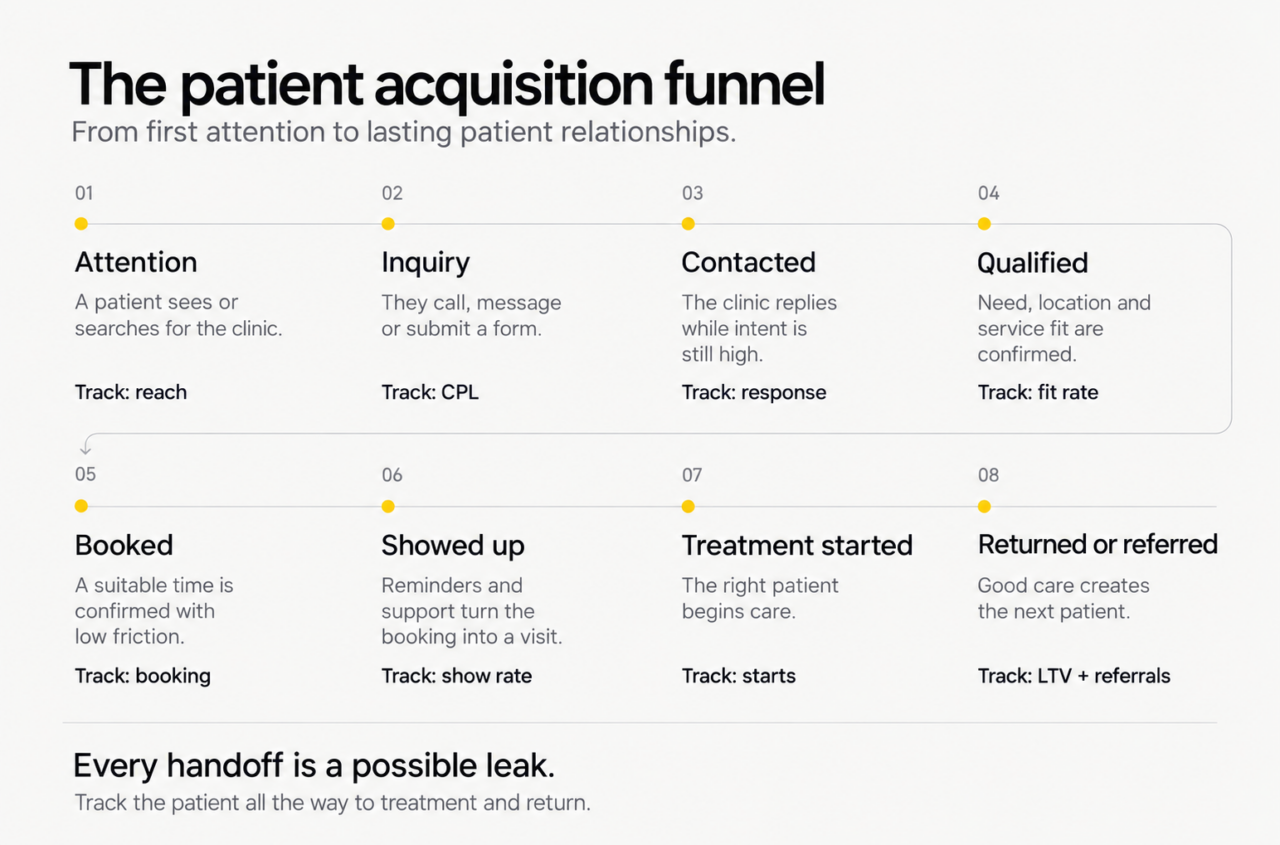
Every arrow is a possible leak.
A cheap inquiry that never answers is expensive. Likewise, a missed appointment produces zero treatment revenue. Patients who arrive for the wrong service consume time and leave disappointed.
So the metrics have to become progressively deeper:
Cost per lead → cost per contacted lead → cost per qualified inquiry → cost per booking → cost per attended appointment → cost per treatment started.

Speed-to-lead: respond while intent is alive
When someone makes an inquiry, their motivation is fresh. They may also be contacting other clinics.
General lead-response research found conversion rates were more than eight times higher when the first attempt happened within five minutes compared with attempts made later. The 2021 study examined 55 million sales activities across 5.7 million inbound leads. It is a cross-industry finding rather than a clinic benchmark, but the operational lesson applies: paid intent decays quickly. See the InsideSales lead-response research.
Speed-to-lead means confirming the inquiry immediately, explaining the next step, asking only the necessary qualification questions and offering relevant times. Sensitive or urgent inquiries go straight to trained staff.
Therefore, the clinic should measure median response time and the percentage of inquiries contacted within five minutes, 15 minutes and one hour.
Make booking easy in your patient acquisition funnel
After contact comes booking. This step often contains unnecessary friction.
The patient waits for a callback. The suggested time does not work. Another message is sent. The conversation moves between phone, text messages and email. The patient disappears.
Instead, high-intent patients should be able to see appropriate availability and complete the next step quickly. The clinic can collect the information required for scheduling while leaving medical assessment to qualified professionals.
Measure inquiry-to-booking rate by source, treatment, location and response-time band. This will reveal whether the problem comes from the channel or the handoff.
Booking is only halfway
However, the next major drop often happens between booking and attendance.
Therefore, every clinic should measure show rate by channel, treatment, location, waiting time and appointment type. A campaign that generates 50 bookings with a 50% show rate may be weaker than one that generates 35 bookings with an 85% show rate.
Evidence from outpatient care shows reminders can materially improve attendance. In one randomized study of 9,835 scheduled visits, the no-show rate was 23.1% without a reminder, 17.3% with an automated reminder and 13.6% with a staff reminder call. Read the PubMed study.
The best reminder flow does more than say, “Appointment tomorrow.” It confirms the location, shares approved preparation instructions, makes rescheduling simple and routes questions to the right person.
A broader systematic review found modest overall improvement from attendance interventions, with no single tactic consistently superior across every population. See the systematic review. Clinics should combine automation with targeted human contact and learn which approach works for their patients.
Connect patient acquisition to treatment and revenue
Finally, the funnel continues after the patient enters the clinic.
Track whether the appointment was suitable, whether treatment began and whether the patient returned or referred someone. These outcomes show marketing which sources and messages create valuable, appropriate demand.
Tracking the full funnel connects all four marketing channels.
Part Three: AI Agents for Patient Acquisition and Marketing Automation
Together, the channels and funnel in a patient acquisition engine create a lot of work.
Someone has to inspect every search term, monitor every Meta creative, follow up with every inquiry, remind every booking, analyze every no-show and connect every result back to revenue.
That is too much work to manage by hand. It is also too important to check only once a week. Instead, agents help your team monitor the acquisition system.
Humans remain responsible for patient care, medical claims, creative judgment, sensitive communication and commercial decisions. Agents provide the speed, memory and continuous attention required around them.
For a broader introduction, read our guide to automating marketing and sales with AI tools. Then apply that approach to the clinic workflows below.
AI agents vs. automation: what should a clinic use?
Healthcare marketing automation handles repeatable tasks, such as sending an approved reminder after a booking. An AI agent can use context and connected tools to decide which steps to take toward a goal. Anthropic describes this distinction as predefined workflows versus systems that choose their own steps and tool use.
For example, a reminder workflow follows a schedule. In contrast, an AI marketing agent could investigate a drop in appointment bookings, compare approved reports and recommend a change. The clinic still sets the access, spending limits and actions that require review.
Start with the simplest approach that does the job. Use routine automation for predictable steps and agents for work that needs investigation. If you are planning the budget, read our guide to AI marketing automation costs for small businesses.

The Company Brain: connect your patient acquisition data
The Company Brain connects approved marketing and appointment data so agents can improve patient acquisition.
Think of it as the part that stops seven agents from behaving like seven interns who never speak to each other.
Most clinics already have plenty of data. The problem is that the data lives in separate systems.
Google Ads knows which keywords produced a form submission. Meta knows which creative generated a lead. Meanwhile, the CRM records whether somebody was contacted. Booking data confirms whether they made an appointment. The clinic management system then records attendance and treatment starts. Finance knows how much revenue was eventually generated.
Each system understands one piece of the journey. Almost none of them understands the whole thing.
As a result, this creates a dangerous gap between marketing performance and business performance.
A campaign can appear successful because it generated 100 inquiries at a low cost. But perhaps only 30 people answered the phone, 12 booked an appointment, eight showed up and three started treatment. Another campaign may generate only 40 inquiries at a higher cost, but produce 15 new patients.
The first campaign wins inside the advertising dashboard. In contrast, the second campaign wins for the clinic.
The Company Brain should connect only the signals your clinic has approved for that system. Use aggregate or de-identified reporting where appropriate, with access limited to each agent’s role. This helps the team evaluate attended appointments, treatment starts and revenue without giving every tool access to patient records.
Give the patient acquisition engine the right context
It learns the clinic’s operating context:
- What counts as a qualified patient inquiry?
- Treatment value and suitability
- Available appointment capacity by location
- Accepted insurance plans and networks
- How far are patients willing to travel for a particular treatment?
- Doctor and specialist availability
- Campaigns that produce inquiries but poor attendance
- Messages that attract patients ready to begin treatment
- Reminder sequences that reduce no-shows
- Reviews or complaints affecting patient confidence
This matters because marketing decisions should reflect what is happening inside the clinic.
If one location is fully booked for the next three weeks, the system should stop sending more demand there. Meanwhile, budget can shift to another location with empty appointment slots. If a particular procedure generates plenty of leads but very few attended consultations, the clinic may have a follow-up, pricing or expectation problem rather than an advertising problem.
At Nas.com, connected sources can refresh every 10–15 minutes. This lets your acquisition system use recent data instead of waiting for a weekly report.
Ask questions that lead to action
A clinic leader should be able to ask the Company Brain:
- What changed today?
- Why did booked appointments fall?
- Where are patients dropping out?
- Which campaigns are producing attended appointments?
- Where do we have unused treatment capacity?
- Does a location need more demand?
- What ads attract patients who are a good fit for our services?
- How much advertising spend is being lost on unqualified inquiries?
- What should the team do next?
The value is not another dashboard. Clinics already have enough dashboards.
The value is having one intelligence layer that can see the entire patient journey, explain what is happening and coordinate the agents responsible for improving it.
Give each agent one clear job
General-purpose AI sounds exciting until you ask it to run a real marketing operation.
A useful agent needs a clearly defined job, access to the correct information and boundaries around the actions it can take. The Google Ads Agent should not try to manage patient reviews. The Reputation Agent should not decide how much to bid for “MRI scan near me.”
Each agent specializes in one part of the patient acquisition engine. Meanwhile, the Company Brain keeps them focused on the same business outcome.
The Google Ads Agent captures patients who are already looking
Google Ads sits closest to existing patient demand.
Someone searching for “dermatologist near me,” “MRI appointment near me,” or “same-day dental appointment” is already aware of a need. The clinic does not have to manufacture interest from scratch. It has to appear for the right search, in the right location, with the right offer, at the right moment.
That sounds simple. In practice, a Google Ads account can contain thousands of small decisions across keywords, search terms, locations, bids, devices, schedules, landing pages and campaign types.
Most of those decisions receive limited human attention.
The Google Ads Agent monitors those decisions continuously. It can examine:
- Which search terms are consuming budget
- Which keywords produce qualified inquiries
- Search keywords that produce attended appointments
- Locations generating suitable patient inquiries
- Whether bids are competitive enough to appear
- Whether broad-match terms are introducing irrelevant traffic
- Which days and hours produce the best booking rates
- Whether mobile and desktop traffic behave differently
- Which landing pages convert inquiries into appointments
- Whether particular campaigns are limited by budget
- Whether competitors are affecting impression share
- Which treatments are gaining or losing search demand
Turn search data into decisions
The difference is in the depth of the answer.
“Cost per lead increased by 18%” is an alert. A person still has to investigate it.
“Three broad search queries consumed 28% of yesterday’s spend, produced 17 inquiries and resulted in zero attended appointments” is a diagnosis.
Now the clinic has something it can act on.
The agent might recommend adding negative keywords, reducing bids, moving budget into higher-intent searches or separating a valuable treatment into its own campaign. Depending on the clinic’s rules, it could prepare those changes for approval or execute low-risk optimizations automatically.
For this reason, downstream reporting matters. If you measure only form submissions, a cheap lead can look like success. Within an approved reporting environment, an agent can use aggregate appointment trends to recommend better budget decisions. This does not require sending individual treatment outcomes to Google.
For clinics, that distinction can change the economics of the entire channel.
The Meta Ads Agent manages the creative machine
Google captures demand that already exists. Meta often creates demand before the patient starts actively searching.
A person may have lived with back pain for six months without looking for a specialist. They may have considered a cosmetic treatment without understanding the options. They may know they need a health screening but continue postponing it.
The right creative can move that person from passive awareness to action.
The challenge is volume.
A growing clinic might be running dozens or hundreds of ads across different treatments, locations, patient concerns, formats and audiences. Performance changes quickly. One creative fatigues. Another attracts attention but produces low-quality inquiries. A third has an expensive cost per lead but generates patients who consistently attend and begin appropriate treatment.
The Meta Ads Agent watches this creative system at the individual-ad level. It can evaluate:
- Spend by creative
- Cost per inquiry
- Click-through rate
- Hook rate and video retention
- Landing-page conversion
- Inquiry quality
- Appointment booking rate
- Attendance rate
- Treatment-start rate
- Revenue by creative
- Creative fatigue
- Audience saturation
- Performance by location, treatment and message
- Whether budget is continuing to flow into a losing ad
Learn from each creative
This is where granularity matters.
For one diagnostic and medical testing company, more than 400 Meta creatives were running each week. The company had an experienced internal marketing team and an external agency. Even then, one underperforming creative continued spending money for more than ten days.
The problem was not a lack of talent. It was the difficulty of inspecting hundreds of assets, every day, at the same level of detail.
The Meta Ads Agent identified the creative, showed why it was wasting budget and recommended turning it off. The marketing team reviewed the recommendation, agreed and stopped the spend.
That is the job: finding the decisions that matter before they sit unnoticed for another ten days.
Turn results into the next experiment
A strong Meta Ads Agent should also help the clinic understand why creative works.
For example, patient testimonials may attract fewer leads but much stronger attendance. “Same-week appointments” might also work better than a discount. Educational videos could produce more serious inquiries than before-and-after imagery. In contrast, an ad that sets the wrong expectation may create a high cancellation rate later.
The agent should return with a point of view: “I found something. Here is what I think is happening. To test that, I would run this experiment next. It could answer a question the advertising dashboard cannot resolve.”
Over time, those findings become institutional memory. The clinic stops repeating failed ideas and begins producing more creative based on what actually brings the right patients through the door.
The Reputation Agent protects the moment of trust
Before booking a clinic, many patients check reviews.
They want to know whether the doctors listen and the front desk answers. They also look for clear prices and appointments that run on time. Above all, they want to understand whether other patients felt safe and had a good experience.
Advertising may create the interest, but reputation often determines whether that interest becomes a booking.
The Reputation Agent monitors the places where patients talk about the clinic. It can:
- Detect new reviews as they appear
- Identify urgent or potentially damaging complaints
- Group reviews by recurring topic
- Compare sentiment across clinic locations
- Draft responses using the clinic’s tone
- Escalate sensitive reviews for human approval
- Track whether the same operational complaint keeps appearing
- Identify positive reviews that could inform future advertising
- Alert the appropriate location or department
- Measure whether reputation improvements affect booking conversion
Use reviews to improve clinic operations
This goes beyond replying to people online.
If patients repeatedly complain that nobody answers the phone, the problem affects speed to lead. Similarly, reports of prices changing after booking point to an expectation problem. If one location receives consistent praise for a particular doctor, that may become a valuable creative angle.
The agent turns reviews into operating intelligence.
We saw this with an education company receiving roughly ten negative reviews a day. The volume made it difficult for the team to notice and address every issue quickly. The Reputation Agent surfaced the reviews as they appeared, organized the problems and enabled the team to respond immediately.
Once those complaints stopped sitting unanswered, trust improved and the company saw its booking rate increase.
For a clinic, the principle is the same. A patient comparing three providers may never tell you that a series of unanswered one-star reviews changed their decision. They simply book somewhere else.
The Reputation Agent helps the clinic catch that invisible leak.
The Reporting Agent connects marketing to attended appointments and revenue
Most clinic reports end too early.
They show impressions, clicks, inquiries and cost per lead. Those metrics are useful, but none of them confirms that a patient arrived at the clinic.
The Reporting Agent follows the journey further:
Ad → Inquiry → Contacted → Qualified → Booked → Attended → Started treatment → Returned or referred
As a result, this creates a very different weekly conversation.
For example, compare two channels using the same acquisition cohort. These illustrative numbers show why a lower cost per inquiry does not always mean a lower cost per attended appointment:
| Metric | Meta Ads | Google Ads |
|---|---|---|
| Inquiries | 90 | 45 |
| Cost per inquiry | $24 | $51 |
| Advertising spend | $2,160 | $2,295 |
| Attended appointments | 14 | 19 |
| Ad cost per attended appointment | $154.29 | $120.79 |
However, Google has the higher cost per inquiry but the lower ad cost per attended appointment. Also, include other acquisition costs when you calculate your clinic’s full cost per patient.
The Reporting Agent can monitor:
- Cost per qualified inquiry
- Contact rate
- Average speed to lead
- Booking rate
- Time between inquiry and appointment
- Cancellation rate
- No-show rate
- Cost per attended appointment
- Treatment-start rate
- Revenue by channel
- Revenue by campaign or creative
- Performance by location
- Performance by treatment
- Capacity against incoming demand
- Patient lifetime value where data is available
Find the cause of a change
It should also identify the reason behind a change.
If appointment volume falls, did lead volume decline? Has response time increased? Did the front desk contact fewer patients? What happened to booking conversion? Have no-shows risen? Was a location closed? Did one strong campaign run out of budget?
Without this breakdown, teams often blame advertising for a problem that happened after the lead was generated.
The Reporting Agent shows exactly where the funnel changed, while the Company Brain gives the other agents the information needed to respond.
For example, the Google Ads Agent can reduce spending on searches that generate poor attendance. Meanwhile, the Meta Ads Agent can develop new creative for an underused treatment. Reputation monitoring can also reveal complaints hurting trust. A follow-up agent can contact new inquiries faster and send reminders before appointments.
As a result, your marketing tools work as one connected patient acquisition system.
Each agent watches one part of the patient journey. Every agent shares what it learns. The system sees, investigates, judges, acts and learns continuously.
Throughout this process, the clinic’s people still provide the judgment, patient empathy and clinical context. The agents provide the attention span, speed and consistency required to make hundreds of small decisions every day.
Together, they keep marketing running long after somebody has closed the weekly report.
Agents should move through one operating loop
The system becomes powerful when every agent shares what it learns:
A dashboard sees that cost per patient increased. An agent investigates whether the change came from advertising, lead response, booking or attendance. It judges which issue matters, recommends or completes an approved action, and learns from the result.
Seeing is easy. Knowing what to do next is the valuable part.
US patient acquisition: protect patient data
Also, separate marketing tasks from clinical decisions. Agents can flag trends, prepare reports and draft approved messages. Clinicians remain responsible for care, while authorized staff handle sensitive communication. Limit access by role and review any new data connection before turning it on.
Building the clinic always-on patient acquisition engine in 90 days
Month one: connect and measure. Map the full funnel. Identify advertising, CRM and booking data, then approve the access and privacy controls for each connection. Define qualified inquiry, booked appointment, attended appointment and treatment started. Establish speed-to-lead and show-rate baselines.
Month two: fix the largest leak. Deploy the agent closest to the constraint. If Google produces irrelevant inquiries, begin there. When Meta leads disappear, focus on qualification and follow-up. If bookings fail to attend, build the reminder and escalation workflow.
Month three: create the learning loop. Use approved internal reports to connect marketing decisions with appointment outcomes. Share only permitted events with advertising platforms. Launch one educational webinar. Strengthen reputation monitoring. Add reporting that explains the next decision, not only the latest numbers.
An always-on acquisition system does more than run ads every day.
It is a clinic learning every day.
The four channels create demand. Next, the funnel turns demand into patients. Throughout the journey, agents respond at the moment of intent and identify where people are falling away.
Humans still provide the care, trust and judgment.
Agents make sure fewer patients are lost between attention and arrival.
Patient acquisition FAQs for medical practices
What is patient acquisition?
Patient acquisition is the process of helping new patients discover your practice, choose it and attend their first appointment. It includes marketing, inquiry handling, scheduling and follow-up. An effective system connects those steps so your team can see where people drop out.
How can a medical practice get more patients?
First, make your local listings and service pages clear and accurate. Then respond promptly to inquiries, explain booking steps and offer useful appointment reminders. Test relevant marketing channels after those basics work. This helps your practice convert existing interest before it spends more to attract new inquiries.
Which patient acquisition metrics should clinics track?
Track response time, contact rate, booking rate, attendance rate and cost per attended appointment. For a consistent comparison, divide the same set of acquisition costs by new patients who attended in the measured cohort. Also, review treatment starts and capacity within your approved internal reporting system.
Can AI automate medical practice marketing?
AI can support tasks such as ad monitoring, reporting and drafting follow-up messages. However, useful healthcare marketing automation needs approved data access, clear limits and human review. Start with one task, measure the result and expand only when the workflow works reliably.