Is AI marketing automation actually affordable for small businesses?
The honest answer: yes, far more than most solo sellers realise. A DIY stack of separate marketing tools typically costs $200 to $500 per month before you spend a single dollar on ads. However, platforms like Nas.com include AI marketing automation for small businesses built directly into the platform, starting at $9 per month, so you get automated ad creation, AI-generated content, and customer targeting without stitching together half a dozen subscriptions.
Why Most Solo Sellers Are Getting Left Behind
Right now, a seller in your niche is getting more visibility, more clicks, and more sales than you are. They might not be a better seller. They might not have a bigger budget. In fact, they might be spending less every month than you think is even possible. The difference, increasingly, is that they are using AI marketing automation for small businesses and you are not.
That gap is real, and it is quietly widening. Online marketing for small businesses used to mean hiring an agency, building a team, or spending months learning a craft that most people running their own stores simply do not have time for. Therefore, when AI marketing tools started to emerge, most solo sellers assumed they were just a more expensive version of the same problem: built for enterprise budgets, requiring technical expertise, and designed for businesses with dedicated marketing departments.
That assumption is now wrong. However, the misinformation has stuck around, which means a lot of sellers are sitting on the sidelines while AI does the heavy lifting for their competitors. This article gives you the honest answer on what AI marketing automation for small businesses costs, what it actually does, and where the most accessible entry point really is.

What AI Marketing Automation Actually Does
Strip away the buzzwords, and AI marketing automation for small businesses refers to software that handles four core tasks: creating content, running ads, finding the right customers, and delivering follow-up messages at the right time. Those four tasks represent the bulk of what a traditional small business marketing team would spend most of its hours on. As a result, automating them has an outsized effect on productivity and reach.
Content creation, in this context, means generating product descriptions, social media posts, email copy, and ad creative from a brief or a prompt. Rather than spending hours writing from scratch, an AI tool generates polished drafts in seconds. In practice, therefore, a seller can maintain a consistent social presence without it eating into their entire week.
Ad creation and management goes further. The more advanced tools in this category write the ad, build the targeting parameters, and run the campaign on platforms like Meta, all without requiring you to navigate a complex ads dashboard or understand the logic of audience segmentation. For sellers who have never run a Meta campaign, this is the benefit of digital marketing for small businesses that previously required either a specialist or a steep learning curve.
Customer targeting, meanwhile, is the process of identifying who is most likely to buy, then making sure your content and ads reach those people specifically. Traditionally, this required manual audience research and ongoing campaign adjustments. AI tools handle this continuously in the background, which means your marketing gets more effective over time rather than stagnating.
💡 Worth knowing: AI marketing tools do not replace the need for a genuine product or service that people want. However, they dramatically lower the barrier between having something worth selling and actually getting it in front of the right people.
The Net Effect on a Solo Seller’s Week
The combined effect is that a solo seller using AI marketing automation for small businesses can maintain the kind of consistent, targeted marketing presence that previously required a small team. That is the actual value proposition. The question, however, is what it costs to access it.
Honest BreakdownWhat the Popular AI Marketing Tools Actually Cost
This is where most conversations about AI marketing automation for small businesses either get vague or get dishonest. So here is the real picture, based on what the most widely used platforms charge for a business at the early to mid growth stage.
The first category is email marketing. Platforms like Klaviyo and Mailchimp are the standard choice for small business email automation. Both offer free plans for small lists, but in practice, once you have a working audience you move into paid tiers. Klaviyo’s pricing starts from approximately $20 per month for up to 500 contacts, and it scales up meaningfully as your list grows. Mailchimp’s Standard plan starts from around $20 per month for a small list, though its price also increases with your audience size.
The second category is social media scheduling and management. Tools like Hootsuite, Buffer, and Later sit in this space. Buffer starts from around $6 per month per channel, though a useful multi-channel setup typically brings the cost to $18 to $36 per month. Hootsuite’s Professional plan, by contrast, starts from $99 per month. These tools schedule your posts, but notably, they do not write the content for you.

The Tools That Write, Design, and Run Ads
Therefore, to get the content written, you need an AI copywriting tool. Platforms like Copy.ai and Jasper are the most widely used for this purpose. Copy.ai’s plan begins at $29 per month, while Jasper’s Pro plan starts at $69 per month. These tools produce written content but do not handle design, scheduling, or ad placement.
For design, most small business owners turn to Canva Pro, which costs approximately $15 per month. It covers visual content but, again, does not connect to your ad accounts or distribute anything automatically.
Finally, there is paid advertising. Meta Ads Manager itself is free to use, but your ad spend is a separate and ongoing cost. Industry experience suggests that meaningful results from Meta ads typically require a minimum spend of $150 to $300 per month, though many marketing guides recommend higher starting budgets for reliable data.
What a Typical Monthly Bill Looks Like
| Tool Category | Common Options | Typical Monthly Cost | What It Does Not Cover |
|---|---|---|---|
| Email marketing | Klaviyo, Mailchimp | From $20-$45+ | Ads, social content, product photography |
| Social scheduling | Buffer, Later, Hootsuite | From $18-$99 | Writing the content, running ads |
| AI copywriting | Copy.ai, Jasper | From $29-$69+ | Design, scheduling, distribution, ads |
| Graphic design | Canva Pro | ~$15 | Targeting, ad management, publishing |
| Paid ads (Meta) | Meta Ads Manager | Free platform + $150-$500+ ad spend | You manage all creative and targeting manually |
| Modest DIY total | 4-5 tools combined | $230-$600+ per month | Integration between tools, your time |
That table represents a fairly conservative estimate. In practice, a small business marketing budget that includes all these capabilities routinely lands between $300 and $600 per month before you factor in what you are actually spending on the ads themselves. Moreover, none of these tools were built to work together, which creates a problem beyond cost.
💡 On small business marketing budgets: Common industry guidance suggests allocating 5 to 10 percent of revenue to marketing. For a business generating $3,000 per month, that means $150 to $300 should go toward marketing costs. A DIY tool stack at $300 to $500 per month, therefore, represents a significant share of revenue for early-stage sellers. For a full breakdown of what different marketing packages for small businesses typically include at each budget level, that guide covers the options in detail.
The Hidden Cost of Stitching Marketing Tools Together
The monthly subscription total is only part of the picture. In fact, for most solo sellers, the time cost of managing a DIY marketing stack is a bigger burden than the financial one.
Each tool you add to your stack requires a separate login, a separate learning curve, and a separate set of decisions. You learn the interface for your email platform, then separately learn how to use an AI writing tool effectively, then figure out Canva’s design system, and then attempt to navigate Meta Ads Manager, which has its own substantial complexity. Consequently, by the time you have set everything up, configured the integrations where they exist, and worked out your own workflow for moving between tools, you have spent hours that could have gone into actually running your business.

There is another problem nobody talks about: these tools do not speak to each other. Your email platform has no idea what your ads are doing. The AI copywriting tool does not know what is actually getting clicks. Your social scheduler is not feeding anything back into your ad strategy. So instead of one connected marketing engine, you end up with a bunch of separate moving parts, each doing its own thing, none of them making the others smarter.
Then there is subscription creep. You add a tool to fix one problem, forget about it, and three months later it is still quietly billing you. Industry estimates suggest small businesses commonly underestimate their actual software spend by 30 to 40 percent. When it comes to online marketing tools for small businesses specifically, that gap tends to be even wider, because most people add tools in a panic rather than as part of a plan.
Your Time Is a Cost Too
⚠️ The real cost of DIY marketing: If you spend five hours per week managing a pieced-together tool stack, at a conservative $30 per hour valuation of your time, that is $600 per month in opportunity cost on top of your subscription fees. The total cost of a typical DIY marketing approach is therefore much higher than the subscription line items suggest.
There has to be a better way, right? There is. And it is why the whole idea of finding the right marketing automation platform for small businesses looks very different today than it did two years ago.
The Built-In AlternativeWhat Changes When AI Marketing Is Built Into Your Platform
Nas.com is an AI-powered selling platform built for people who want to sell what they know, what they make, or what they love, without needing a marketing degree or a team behind them. Trusted by more than 350,000 sellers across 150 countries, it was specifically designed to close the gap between having something worth selling and consistently reaching the people who want to buy it.
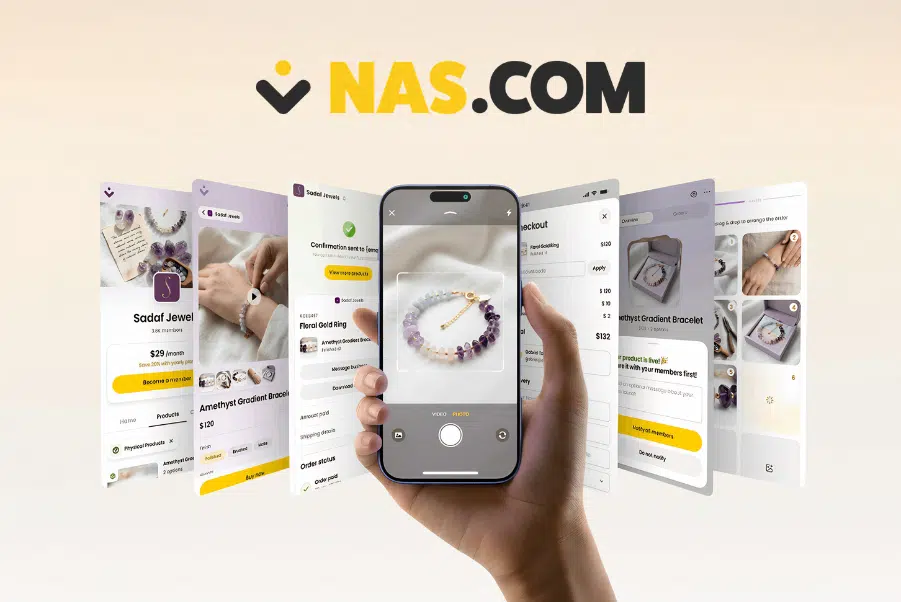
Unlike a standard ecommerce host such as Shopify, which provides the store infrastructure but leaves the marketing entirely to you, Nas.com does the marketing for you. That distinction matters enormously in practice. The platform includes built-in AI that writes your content, creates and runs your ads, and helps identify the right customers, all from the same dashboard where you manage your products and orders. There is no integration to configure, and no expertise required to get started.
Nas.com supports sellers across every category, including physical products, handmade goods, services, events, courses, coaching, and digital downloads. Whatever you are selling, the AI marketing tools work in the same way.
Sell What You Know
Courses, templates, 1:1 sessions, challenges, and community memberships. Your expertise becomes a product, and the AI handles the content and promotion.
Sell What You Make
Jewellery, apparel, ceramics, home decor, handmade goods. Upload one product photo and Magic Content generates studio-quality images, ad creatives, and social content in seconds.
Sell What You Love
Fitness classes, networking events, dance classes, creative workshops. The platform supports events and ticketing alongside physical and digital products.
The AI marketing features at the core of Nas.com fall into three categories, each of which replaces a separate tool you would otherwise need to subscribe to and manage independently.
Magic Ads connects directly to Meta so you can launch Facebook and Instagram campaigns in three clicks: no pixel, no Business Manager, no learning curve. Type one sentence about your product and who you want to reach, and the AI generates professional, photo-quality ad images. Then set your audience and daily budget (the only two decisions you need to make), and your ad goes live. Nas.com handles the entire Meta connection, and you track results in real time from your dashboard. No designer, no copywriter, no ad account expertise required. Magic Ads is available on the Pro plan ($29 per month, with a 10% campaign fee) and the Platinum plan ($99 per month, with a 5% campaign fee).
Magic Content turns a single product photo into your entire marketing toolkit. Upload one photo and it generates studio-quality product images, ad creatives, and social media content in seconds. No designer, no photographer, no separate tools required. Whether you sell physical products, handmade goods, or digital products, everything you need to show up consistently online comes from that one starting point.
Magic Reach is Nas.com’s multichannel messaging tool. Write your message once, hit send, and it gets delivered across email, push notifications, your feed, and WhatsApp direct messages simultaneously. Rather than managing separate tools for each channel or losing members in a basic chat platform, everything goes out in one click. The result is higher open rates, less missed information, and no dependence on a single platform to reach your audience.
In addition to these three core marketing features, the platform includes a broader set of tools designed to support the full business, not just the marketing function.
Global Payments
Accept payments in 190+ countries with 0% Nas fee on physical product sales. Payment processing fees vary by country.
AI Cofounder
An always-on AI partner that helps you make decisions, plan your next move, and grow your business whether you are just starting out or scaling up.
Storefront
A high-converting store built from a single photo. Go live in minutes with no design experience, no coding, and no template wrestling required.
Mobile App
Manage your store, track orders, and engage customers from anywhere. Your whole business in your pocket, without needing to be at a desk.
Community and Events
Host paid communities, challenges, and events from the same platform where you sell your products. No separate event tool needed.
Customer Support
No lock-ins, no small print surprises. Straightforward pricing, responsive support, and a platform built to make your success the priority.
The platform is available on three plans. Each includes a 7-day free trial, and all plans carry a 0% Nas fee on physical product sales (a payment processing fee applies depending on your country). For digital products, the Nas fee is 4.9% on Basic, 2.9% on Pro, and 1% on Platinum. You can review the full Nas.com pricing page for current details.
| Plan | Monthly Cost | Key Features |
|---|---|---|
| Basic | $9/month | Sell up to 5 products (physical, digital, or services), global payments, AI writes product and marketing content, automatic payouts every 2 weeks, 2 free AI credits/month |
| Pro | $29/month | Everything in Basic, plus unlimited products, Magic Ads (AI runs Meta ads, 10% campaign fee), customisable emails, verified seller badge, up to 3 business managers, 5 free AI credits/month |
| Platinum | $99/month | Everything in Pro, plus get paid on demand, Meta ads at 5% campaign fee, built-in affiliate tools, up to 10 business managers, priority support, 10 free AI credits/month |
When a DIY Tool Stack Still Makes Sense
To be fair, Nas.com is not the right answer for every business. There are specific scenarios where the granular control of separate platforms is genuinely worth the added complexity and cost.
🔧 You Have a Dedicated Marketing Team
Best for: Established businesses with two or more full-time marketing staffIf you have team members who specialise in email marketing, paid media, and social content as distinct disciplines, specialist platforms give each of them the depth of functionality their work requires. A paid media manager at a business spending $10,000 per month on ads, for example, benefits from the granular reporting and A/B testing infrastructure that a standalone ads platform provides. However, this scenario assumes significant headcount, an established marketing team for small business, and a budget that most solo sellers are not operating with.
🔧 You Are Managing $5,000+ Per Month in Ad Spend
Best for: High-volume advertisers with complex campaign requirementsAt substantial ad spend levels, granular audience controls, custom attribution models, and sophisticated retargeting logic begin to earn their overhead. At this scale, the 10 to 20 percent efficiency gain from a specialist tool can meaningfully outweigh the cost and complexity. Below that threshold, however, the complexity rarely pays for itself, and the time spent managing it tends to subtract from the time available for the actual business.
🔧 You Are in a Highly Regulated Industry
Best for: Finance, healthcare, or legal service providers with strict compliance requirementsSome industries require specific compliance controls, data handling standards, or approval workflows that specialist platforms are built to accommodate. If your content must be reviewed by a compliance team before publication, or if your email marketing must adhere to strict data regulations, the flexibility of specialist tools may be necessary. For most sellers of physical products, handmade goods, services, and digital products, however, these constraints simply do not apply.
Outside of those three scenarios, a DIY tool stack primarily adds cost and complexity without a corresponding return. The numbers in the next section show exactly how large that gap is.
The Numbers Side by SideThe Real Cost Comparison: DIY Stack vs Nas.com
The most useful way to evaluate AI marketing automation for small businesses is to compare what a working DIY marketing stack actually costs against what the equivalent capability costs on Nas.com. The table below uses conservative estimates for the DIY column and real plan prices for Nas.com.
| Marketing Function | DIY Tool Stack | Nas.com Basic ($9/mo) | Nas.com Pro ($29/mo) |
|---|---|---|---|
| Content creation and scheduling | $47-$267/month (Copy.ai, Jasper, Buffer, Hootsuite) | Included | Included |
| Product photos, ad creatives and social content | $15+/month (Canva Pro) + photographer costs | Magic Content included | Magic Content included |
| AI ad creation and management | $50-$200/month (tool or management fee) | Not included (content only) | Magic Ads included (10% campaign fee) |
| Multichannel messaging | $0-$100+/month (separate email, push, and messaging tools) | Magic Reach included | Magic Reach included |
| Storefront and payments | $29-$79/month (separate ecommerce platform) | Included, 0% Nas fee on physical products | Included, 0% Nas fee on physical products |
| Minimum monthly total | $200-$500+ per month | $9 per month | $29 per month |
The difference is not marginal. It is an order of magnitude. Furthermore, the DIY stack requires you to manage multiple platforms, maintain separate logins, and invest time in learning each tool individually. By contrast, Nas.com consolidates everything into a single dashboard that is specifically designed to require no marketing background to use.
Why Consistency Matters More Than Sophistication
It is also worth noting that ecommerce marketing automation is typically one of the first subscriptions a solo seller cancels when revenue dips. Standalone marketing automation ecommerce tools are external expenses, which means they disappear when budgets get tight and your marketing goes quiet at exactly the wrong moment. By contrast, when your small business marketing automation software is built into the same platform as your store, your payments, and your product catalogue, there is no separate subscription to cancel. The marketing keeps running because it is part of the infrastructure, not an add-on to it.

Who AI Marketing Automation for Small Businesses Is Actually For
The clearest use case for AI marketing automation for small businesses is any seller who is running their business primarily or entirely on their own, without a dedicated marketing team. That includes sellers of handmade goods, clothing, jewellery, and home decor who currently rely on organic social posts and word of mouth. It includes service providers, coaches, and course sellers who know their subject deeply but find the marketing side of the business genuinely difficult to sustain. It also includes side hustlers and part-time sellers who do not have the hours to maintain a complex DIY marketing stack on top of everything else they are managing.
In each of these cases, the value of having AI marketing built into the platform is not just cost savings. It is, in fact, the difference between marketing happening consistently and marketing only happening when you have spare time. For most independent sellers, spare time is in short supply. Consequently, the consistency that comes from an automated system often delivers better results than a more sophisticated manual approach that only gets attention sporadically.
Nas.com is also well-suited to sellers who are considering platforms like Shopify or Etsy for the first time and want to understand the real difference. The key distinction, as it relates to AI marketing automation for small businesses, is that Nas.com includes the marketing, while other platforms simply host your store and leave marketing as your problem to solve. A direct comparison with Shopify makes that difference concrete. For small business internet marketing specifically, it has a significant effect on how quickly a new seller can gain traction without a steep learning curve.
What About Sellers Who Prefer to Do It Themselves?
It is also worth addressing the DIY marketing for small business instinct directly. Many sellers prefer to do everything themselves, and there is genuine value in understanding how your marketing works. However, the goal of AI marketing automation is not to remove your involvement entirely. It is to handle the repetitive, time-consuming execution so that your involvement goes into the decisions that actually require your judgment, such as what to launch next, which products to promote, and how to develop your brand positioning.
The Honest VerdictIs AI Marketing Automation Affordable for Small Businesses?
Yes. However, the more important question is whether small businesses can afford to go without it. The competitive landscape has shifted. Sellers using AI-powered marketing tools are reaching more customers, producing more content, and running more consistent ad campaigns than those who are not. The gap between those two groups is not talent or budget. It is access to the right tools and the decision to use them.
The top rated marketing AI agents for small businesses are no longer only accessible to businesses with enterprise budgets. In fact, the most accessible entry point for the full stack of AI marketing capabilities, including content generation, ad automation, and customer targeting, starts at $9 per month on Nas.com. That is less than a monthly streaming subscription, and it replaces a collection of tools that would otherwise cost $200 to $500 per month to assemble and maintain separately.
The Cost of Waiting Is Rising
For solo sellers and small teams specifically, the best marketing platform for small business is the one that removes the complexity, consolidates the tools, and keeps the marketing running even when you are focused on every other part of the business. Many sellers searching for the best AI for small business marketing, or the best marketing software for small business overall, end up evaluating a dozen separate tools before realising that the most effective form of AI marketing automation for small businesses is not that complicated at all.
Stop doing manually what AI can do for you. The tools exist, the price is accessible, and the only thing standing between you and a marketing system that runs itself is getting started. Try Nas.com free for 7 days.
AI marketing that works for you,
not against your budget.
Join 350,000+ sellers on Nas.com and let the AI handle the marketing while you focus on your business.
Start Free on Nas.com →Frequently Asked Questions
About AI marketing automation for small businesses
Is AI marketing automation affordable for small businesses?
Yes, considerably more so than most sellers realise. While a DIY stack of separate marketing tools typically costs $200 to $500 per month before ad spend, all-in-one platforms like Nas.com include built-in AI marketing starting at $9 per month. That covers AI content generation, automated customer targeting, and on the Pro plan, AI-powered Meta ad campaigns, all without separate subscriptions.
How much does AI marketing automation cost for small businesses?
The cost depends heavily on the approach. A DIY stack combining email marketing, social scheduling, AI copywriting, and design tools typically runs between $150 and $500 per month, plus any paid advertising spend on top. However, all-in-one platforms with built-in AI marketing, such as Nas.com, bring that total down significantly. Nas.com’s Basic plan starts at $9 per month, and the Pro plan, which includes AI-run Meta ad campaigns, starts at $29 per month.
Benefits and budgets
What are the benefits of digital marketing for small businesses?
Digital marketing allows small businesses to reach targeted audiences at a fraction of the cost of traditional advertising, with fully measurable results. The core benefits include the ability to run paid ad campaigns that reach specific customer profiles, generate consistent content without a large team, build an audience across social platforms, and automate customer outreach. With AI-powered tools, these advantages are now accessible to solo sellers who do not have a dedicated marketing team or a large budget.
How much should a small business spend on marketing?
Industry guidance commonly recommends allocating between 5 and 10 percent of revenue to marketing. In practice, however, AI-powered platforms have reduced the minimum effective investment significantly. Platforms like Nas.com allow solo sellers to maintain a consistent marketing presence, including AI-generated content and automated ad campaigns, for as little as $9 to $29 per month. For early-stage businesses, that accessibility makes consistent marketing realistic in a way that a traditional 10 percent budget allocation often does not.
Choosing the right tools
What is the best marketing automation software for small business?
The best option depends on your budget and how much time you want to invest in tool management. For solo sellers and small teams without a dedicated marketing background, an all-in-one platform like Nas.com is typically the most practical choice. It consolidates AI content creation, ad automation, customer targeting, and ecommerce into a single platform, starting at $9 per month. For businesses with a dedicated marketing team and significant ad budgets, specialist platforms offer deeper control, but they come with substantially higher costs and complexity.
About Nas.com and its marketing tools
What is Magic Ads on Nas.com?
Magic Ads is Nas.com’s built-in AI advertising feature. It connects directly to Meta so you can launch Facebook and Instagram campaigns in three clicks: no pixel, no Business Manager, no ad account expertise required. Type one sentence about your product and who you want to reach, the AI generates professional photo-quality ad images, you set your audience and daily budget, and your ad goes live. Nas.com handles the entire Meta connection and you track results in real time from your dashboard. Magic Ads is available on the Pro plan ($29 per month, with a 10% campaign fee on your ad spend) and the Platinum plan ($99 per month, with a reduced 5% campaign fee).
How does Nas.com differ from tools like Shopify or Etsy for marketing?
The core difference is that Nas.com includes the marketing, while platforms like Shopify and Etsy primarily host your store and leave marketing as your responsibility to manage and fund separately. On Shopify, for example, you pay the platform fee and then separately subscribe to marketing apps, email tools, and ad management solutions. On Nas.com, AI-powered content creation, ad automation, and customer targeting are built into the platform from the start. That distinction is particularly significant for solo sellers who do not have the time or background to manage a separate marketing stack. You can read a full breakdown in the Nas.com vs Shopify comparison.
Is there a free trial for Nas.com?
Yes. All Nas.com plans include a 7-day free trial, so you can explore the platform and its AI marketing tools. The trial gives you access to the plan features so you can experience how Magic Content, Magic Reach, and the storefront builder work with your actual products before deciding whether to continue.
Selling physical and digital products
Does Nas.com work for physical product sellers, not just digital products?
Yes, and this is an important point. Nas.com is built for anyone who wants to sell what they know, what they make, or what they love. That includes physical products, handmade goods, jewellery, apparel, ceramics, and home decor alongside digital products, courses, coaching, events, and community memberships. The AI marketing tools, including Magic Content’s product photography and Magic Ads’ campaign automation, are designed to work across all of these categories. On all plans, physical product sales carry a 0% Nas platform fee (payment processing fees apply depending on your country).