What is the best Shopify alternative for solo sellers in 2026?
The best Shopify alternative for solo sellers in 2026 is Nas.com. It is the only platform built specifically for one-person businesses, with AI that writes your content, runs your ads, and helps you sell physical products, services, events, and digital products from a single storefront. Plans start at $9 per month with 0% Nas fees on physical products, global payments in 190+ countries, and a 7-day free trial.
Shopify is the default answer for anyone starting an online store. It is well-known, well-marketed, and built for ecommerce. So why are so many solopreneurs searching for the best Shopify alternative for solo sellers — and quietly walking away?
The honest answer is that Shopify was not built for you. It was built to scale businesses that already have teams, budgets, and dedicated marketing staff. When you are a one-person operation, the mismatch becomes obvious fast. You are paying for infrastructure you do not use, buying apps to fill gaps the core platform leaves open, and navigating a dashboard designed for operations far larger than yours.
Most “best ecommerce platform” guides are written for small businesses with teams of 5, 10, or more — not for independent sellers running everything alone. This guide is different. We looked at the same platforms those posts cover, but ranked them by what actually matters when you are the only person running your store.
The ProblemWhy Solo Sellers Are Leaving Shopify in 2026
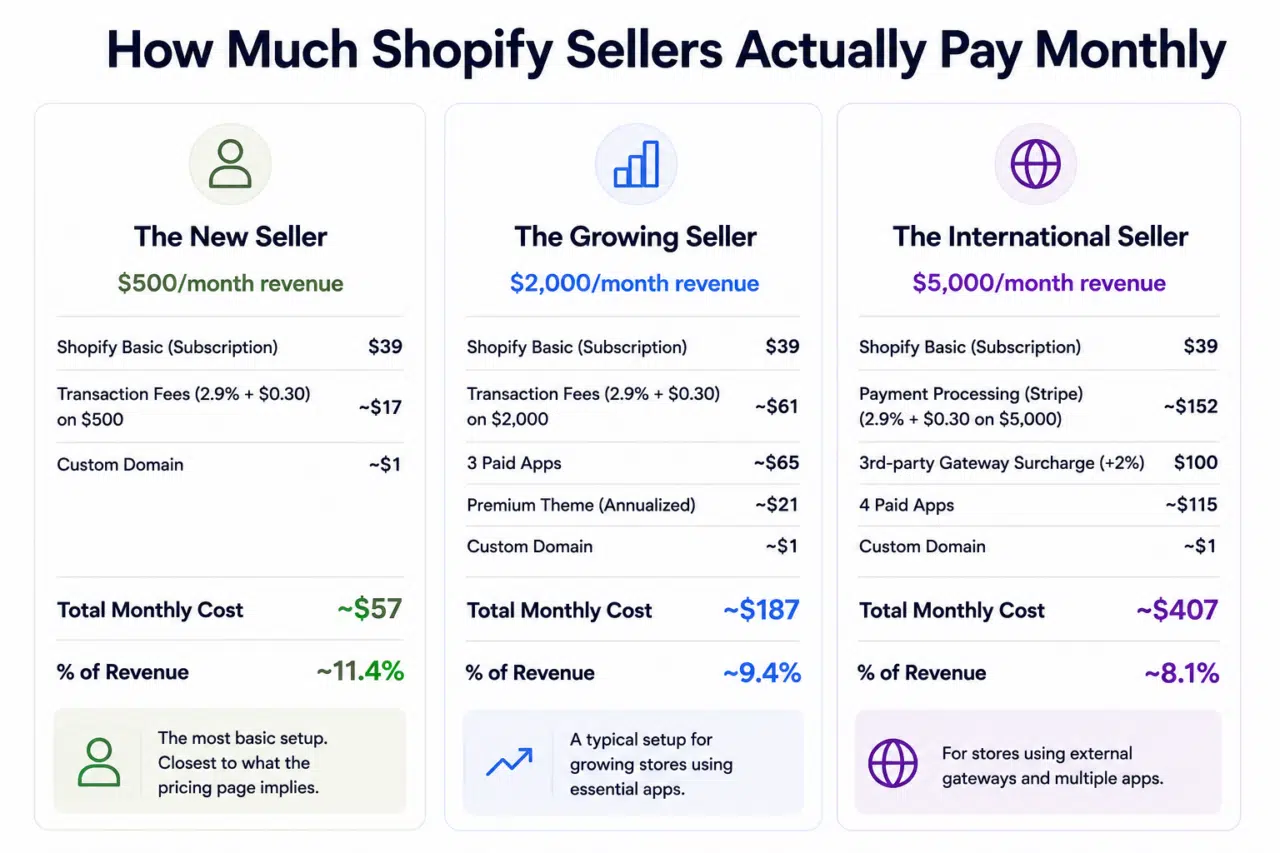
Shopify’s Basic plan starts at $39 per month — but that number covers only your store infrastructure. Once you add the apps most sellers need (email marketing, reviews, abandoned cart recovery), a premium theme, and Shopify’s transaction fees of 2.9% + $0.30 per sale, the real monthly bill looks very different.
A new seller doing $500 per month ends up paying around $57 per month. A growing seller doing $2,000 per month with three paid apps pays closer to $187. An international seller on $5,000 per month, using an external payment gateway and four apps, can hit $407 per month — with Shopify’s 2% third-party gateway surcharge adding $100 of that alone. We broke down every cost layer in our guide on how much Shopify really costs.
None of those figures include the time cost of managing multiple integrations, troubleshooting app conflicts, or learning a platform designed around team workflows. If you are comparing platforms side by side, our Nas.com vs Shopify breakdown covers exactly where the differences add up.
Beyond cost, the deeper issue is relevance. Most Shopify features, including multi-staff accounts, complex shipping rules, wholesale pricing tiers, and advanced B2B tools, exist to serve operations with multiple people and high order volumes. A small business owner who makes handmade products, runs online fitness classes, or sells templates and coaching does not need most of this. What they need is a platform that removes friction, handles the repetitive tasks automatically, and lets them work for themselves online on their own terms.
That gap is exactly what the alternatives below are built to fill. Some do it better than others, as you will see.
Our CriteriaHow We Ranked the Best Shopify Alternatives for Solo Sellers
Every platform on this list was evaluated through the lens of a one-person business. Finding the best Shopify alternative for solo sellers comes down to five criteria:
- Total monthly cost including necessary add-ons
- Ease of getting live without a developer
- Transaction fee structure
- Built-in tools versus paid extras
- Range of what you can sell — physical goods, services, digital products, events, and community memberships
Platforms that require significant technical maintenance or separate hosting management scored lower in our ranking, because for anyone trying to sell online by yourself, time is the scarcest resource of all.
Ranked #1Nas.com: The Best Shopify Alternative for Solo Sellers
Every other platform in this comparison was built for a broader audience and adapted, to varying degrees, for solo entrepreneurs. Nas.com is different. It is the only platform on this list that was designed specifically for a one person online business, with a product philosophy that assumes you are doing everything yourself. That assumption changes what gets built into the core product versus what gets left to third-party apps, and it is why Nas.com earns the top spot in this ranking.
What Nas.com Does Well for Ecommerce
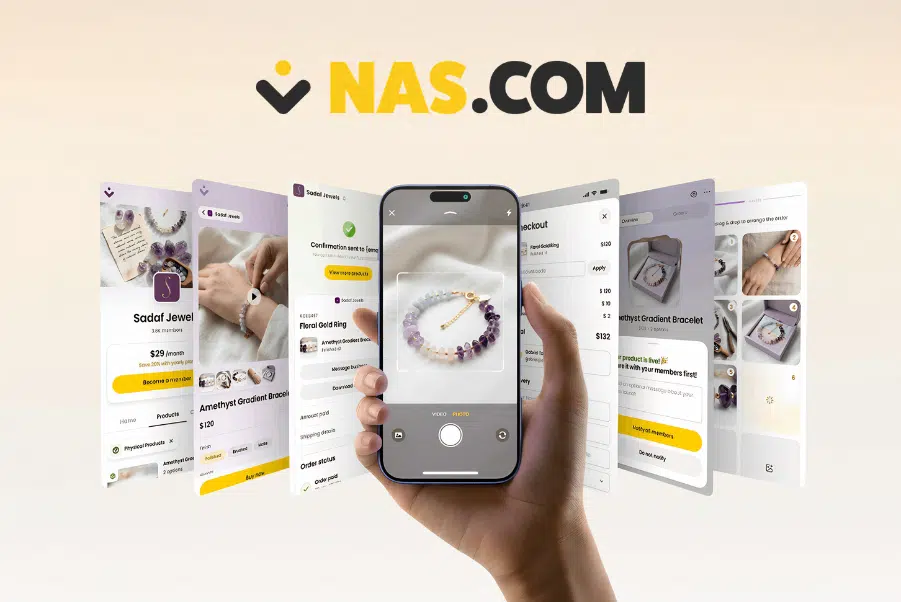
The platform’s tagline is “work for yourself,” and its core pitch is that you can sell what you know, what you make, or what you love. That framing reflects a genuinely broad scope: as a purpose-built AI ecommerce platform, Nas.com handles physical products, handmade goods, digital products, services, coaching, courses, events, and community memberships from a single storefront. You do not need separate platforms for your ceramics shop and your online workshop series. Everything lives in one place, managed from one dashboard, with one set of payments — which is exactly what a solopreneur needs.
Sell What You Know
Courses, templates, 1:1 coaching sessions, challenges, and paid community memberships. Your expertise is a product.
Sell What You Make
Jewellery, ceramics, apparel, home decor, and handmade goods of every kind. Nas.com is one of the simplest ways to sell handmade products online, handling payments and shipping configuration while you take care of fulfilment.
Sell What You Love
Fitness classes, networking events, dance workshops, local experiences. Your time and passion are products too.
The AI Cofounder: Your Always-On Business Partner
The feature that sets Nas.com most clearly apart from every other platform in this comparison is its AI Cofounder. Unlike a basic chatbot or content suggestion tool, this is an always-on AI partner that actively helps you run and grow your business. Product descriptions, marketing copy, studio-quality product photos from a single image, daily social media content, and Meta advertising campaigns — all handled with a launch process that takes three clicks. For a solo entrepreneur managing everything alone, that is the equivalent of having a full marketing team built into your monthly subscription.
Nas.com’s AI-powered Marketing is particularly valuable: running paid ads on Meta requires creative assets, targeting knowledge, budget management, and ongoing optimisation. Most independent sellers either avoid paid ads entirely because of the complexity or spend money inefficiently because they lack the expertise. Magic Ads handles the setup and optimisation automatically, at a 10% campaign fee on the Pro plan and 5% on Platinum. Compare that to what a freelance ads manager charges, and the value becomes clear quickly.
Global Payments With 0% Nas Fee
Nas.com processes payments in over 190 countries via its Zero Link system, with a 0% platform fee on every plan. You pay standard payment processing fees, which vary by country, but nothing additional goes to Nas.com when you’re selling physical products. Nas.com also offers get-paid-on-demand on the Platinum plan, so you are not waiting for a fixed payout cycle when cash flow matters.
Nas.com Pricing & Features
| Plan | Key Features | Nas Fee |
|---|---|---|
| Basic $9/mo |
Sell up to 5 products (physical, digital, or services), accept payments from customers anywhere in the world, get paid every two weeks automatically, AI writes your product and marketing content, 2 free AI credits per month | 0% physical products 4.9% digital products * |
| Pro $29/mo |
Everything in Basic + unlimited products, AI runs your Meta ads (10% campaign fee), customisable emails + verified seller badge, up to 3 business managers, 5 free AI credits per month | 0% physical products 2.9% digital products * |
| Platinum $99/mo |
Everything in Pro + get paid on demand, Meta ads at 5% campaign fee, built-in affiliate tools so others can sell for you, up to 10 business managers, priority support, 10 free AI credits per month | 0% physical products 1% digital products * |
* Gateway fee varies by country. All plans include a 7-day free trial. See the full pricing page for current details.
9 Nas.com Features That Matter for Solopreneurs
Global Payments
Accept payments in 190+ countries via Zero Link. 0% Nas fee. Automatic payouts every two weeks, or on demand on Platinum.
AI Cofounder
Always-on AI that writes your product listings, marketing copy, and social content. Your business partner, built into the platform.
Storefront
Build a high-converting store from a single photo. Go live in minutes, not days. No developer needed.
Magic Content
Studio-quality product photos, polished ads, and daily social content. All AI-generated from your images.
Magic Ads
Launch Meta ad campaigns in three clicks. AI handles targeting, creative, and optimisation. No ads experience required.
Magic Reach
Write your message once and send it across email, push notifications, your feed, and WhatsApp — all in a single click. Nas.com’s most loved feature.
Mobile App
Manage your store, track orders, and engage customers from anywhere. Your business runs from your phone.
Community and Events
Host paid challenges, events, and community memberships from the same platform. No third-party tool required.
Customer Support
No lock-ins. No small print surprises. Honest pricing, transparent terms, and priority support on Platinum.

Wix: Best for Quick Launch and Design Simplicity
What Wix Does Well for Ecommerce
Wix is one of the most popular website builders in the world and a reasonable option for small business owners who prioritise speed and visual appeal over depth of selling tools. Its drag-and-drop editor is genuinely beginner-friendly, making it a solid ecommerce platform for beginners, and the template library is extensive enough that most sellers can find a starting point without hiring a designer.
Wix Pricing & Features
| Plan | Key Features | Transaction Fee |
|---|---|---|
| Core $29/mo |
Basic ecommerce, 50 GB storage, basic marketing suite, scheduling and services, 5 collaborators | 4% |
| Business $39/mo |
Standard ecommerce, 100 GB storage, standard marketing suite, scheduling and services, 10 collaborators | 2% |
| Business Elite $159/mo |
Advanced ecommerce, unlimited storage, advanced marketing suite, advanced developer platform, 100 collaborators | 0% |
Standard payment processing fees apply on all plans.
Where Wix Falls Short for Solo Sellers
However, Wix has a well-known limitation that catches sellers out later: once you choose a template, you cannot switch to a different one without rebuilding your site from scratch. Beyond that, Wix is primarily a website builder with ecommerce added on. Its marketing automation, ad management, and AI tools are useful at surface level, but they are not purpose-built for selling. There is no equivalent of running Meta ads in three clicks, generating studio-quality product photos automatically, or managing community memberships and events from the same dashboard. Wix also has limited global payment reach compared to platforms built specifically for international selling.
For independent sellers who need to be live quickly and have a small, stable product catalog, Wix is a competent and affordable option. For anyone who wants their platform to actively help them grow, rather than simply host their store, it falls short of what Nas.com offers at a comparable or lower price point.
What you can sell: Physical products and digital downloads. Services and appointments are supported via Wix Bookings, but events, community memberships, and courses require separate paid apps.
Best for: Small business owners who want a visually polished store quickly and are comfortable managing their own marketing separately.
Ranked #3Squarespace: Best for Visual and Creative Brands
What Squarespace Does Well for Creative Sellers
Squarespace has earned its reputation for design quality. Its templates are among the best-looking in the industry, and the platform has historically attracted photographers, artists, and designers who want their storefront to reflect the standard of their work. Getting live is straightforward — no coding required, and most sellers can have a store up within a day using one of the guided setup flows. The 2025 Beacon AI update added an AI assistant for setup and content guidance, though most advanced marketing tools such as email automations and abandoned cart recovery require upgrading to higher plans or adding paid extensions.
Squarespace Pricing & Features
| Plan | Key Features | Store Fee | Digital & Memberships Fee |
|---|---|---|---|
| Basic $25/mo |
Sell products and services, send invoices, sell content and memberships, Squarespace AI, up to 2 contributors | 2% | 7% |
| Core $45/mo |
Everything in Basic + unlimited contributors, advanced analytics, CSS/JS customisation, professional shipping and tax, sales funnel analytics | 0% | 5% |
| Plus $69/mo |
Everything in Core + lower payment processing fees (2.7% + $0.30) | 0% | 1% |
| Advanced $139/mo |
Everything in Plus + lowest payment processing fees (2.5% + $0.30), most advanced commerce tools | 0% | 0% |
Credit card processing starts at 2.9% + $0.30 on Basic and Core plans. All prices are monthly billing.
⚠️ Watch the transaction fee trap: Squarespace’s Basic plan starts at $25 per month but charges 2% on every store transaction and 7% on digital content and memberships. To eliminate the store transaction fee, you need to upgrade to Core at $45 per month.
Where Squarespace Falls Short for Solo Sellers
Squarespace is primarily a design-first website builder. While its ecommerce functionality has improved significantly, it still lacks the depth that a dedicated selling platform provides. There is no built-in AI ad management, no tool to run Meta campaigns automatically, and no way to generate studio-quality product photos without a third-party app. Global payment reach is also more limited compared to platforms built specifically for international sellers. For a solopreneur who wants their platform to actively drive growth rather than simply display their products, Squarespace requires significant additional investment in tools and time.
What you can sell: Physical products, digital downloads, services, appointment bookings, online courses, and content memberships. Events and community features are not natively supported.
Best for: Creative independent sellers including photographers, designers, and artists whose brand identity depends heavily on visual presentation and who sell primarily in a single market.
Ranked #4WooCommerce: Best for Full Technical Control
What WooCommerce Does Well for Ecommerce
WooCommerce is the most widely used ecommerce plugin for WordPress, and its appeal is genuine for the right kind of seller. You own your data completely, there are no platform transaction fees, no revenue share, and no additional fee for using third-party payment solutions. You also have access to tens of thousands of plugins, meaning virtually any functionality can be added to your store. For sellers who are technical or who have a developer relationship, WooCommerce offers a level of control that no hosted platform can match.
WooCommerce Pricing & Fees
| Fee Type | Cost |
|---|---|
| Platform fee | $0 (free plugin) |
| Hosting | Your choice — from ~$250/year |
| Card payment processing | ~2.50–2.90% + $0.30 per transaction with WooPayments |
| Third-party payment gateway fee | None |
| Revenue share | None |
| Subscription processing fees | None with WooCommerce Subscriptions |
| Global selling fee | $0, sell in unlimited markets |
| Product variant limits | Unlimited |
💡 The real WooCommerce cost: Plugin is free. Add hosting ($250/year minimum), a premium theme ($50 to $100), and essential paid plugins ($200 to $600/year). Budget 15 to 30 hours for initial setup and ongoing monthly maintenance. This trade-off is significant for anyone running an online store alone, where time is the most valuable resource.
Where WooCommerce Falls Short for Solo Sellers
The maintenance burden is the key issue. WordPress requires regular updates to the core platform, your theme, and every plugin. A missed update can introduce security vulnerabilities, and a plugin conflict can take your store offline. Furthermore, performance optimisation requires understanding caching, CDN configuration, and image compression. For a one-person operation, all of that is time not spent on selling, creating, or serving customers. There are also no built-in AI tools, no ad management, and no community or events functionality without additional paid plugins.
What you can sell: Physical products, digital downloads, services, subscriptions, and memberships. Events and community features require separate plugins.
Best for: Independent sellers with technical experience, an existing WordPress site, or a developer relationship who want full ownership and zero platform fees.
Ranked #5Big Cartel: Best for Artists Selling Small Collections
What Big Cartel Does Well for Ecommerce
Big Cartel occupies a genuinely useful niche that the bigger platforms ignore: artists, makers, and independent sellers with small, carefully curated product catalogs. The free Gold plan lets you accept payments, list up to 5 physical products, and get a mobile-friendly shop template with zero transaction fees. There is no credit card required and no time limit, making it a real free tier, not a trial.
Big Cartel Pricing & Features
| Plan | Key Features | Transaction Fee |
|---|---|---|
| Gold Free |
Up to 5 physical products, accept payments online, mobile app for iOS and Android, sales tax autopilot, import products from Etsy, Squarespace, and Shopify, free mobile-friendly template, basic sales reporting | 0% |
| Platinum $15/mo |
Everything in Gold + up to 50 physical products, sell digital goods and services, custom domain, discount codes, sell in person, inventory tracking, print shipping labels + up to 90% off shipping, shipment tracking, run ads, Google Shopping connection, edit products in bulk, easy-install apps for print-on-demand and reviews | 0% |
| Diamond $30/mo |
Everything in Platinum + up to 500 physical products, abandoned cart recovery, schedule product drops, advanced discount logic, password-protect products, connect to 7,000+ apps via Zapier, priority support | 0% |
Standard payment processing fees apply on all plans.
Where Big Cartel Runs Out of Road
That said, the platform does not offer email marketing tools, built-in ad management, AI content tools, or community and events functionality on any plan. Big Cartel is designed to stay simple on purpose, which means it actively resists the features a growing solopreneur eventually needs. Furthermore, there is no upgrade path beyond Diamond, so when you outgrow it, you are starting over somewhere else.
What you can sell: Physical products on all plans. Digital goods and services from Platinum upward. No native support for events, community memberships, or courses.
Best for: Artists and independent sellers with a small catalog and a loyal existing audience who have no immediate need for marketing automation or growth tools. Think ceramicists selling limited collections, printmakers running editions, or jewellery makers listing new work monthly.

Best Shopify Alternatives for Solo Sellers: Full Comparison Table
| Platform | AI Tools | Global Payments | Events + Community | Best For |
|---|---|---|---|---|
| Shopify From $39/mo |
Basic AI copywriting | Yes (varies by country) | Via paid apps only | Teams and growing businesses |
| Nas.com From $9/mo |
Full AI Cofounder, Magic Ads, Magic Content, Magic Reach | 190+ countries | Yes, built in | Solopreneurs and independent sellers of all types |
| Wix From $29/mo |
Wix AI (Aria), basic design tools | Limited countries | Limited, via apps | Design-first small stores |
| Squarespace From $25/mo |
Squarespace AI, Beacon AI | Limited countries | Courses and memberships only | Visual and creative brands |
| WooCommerce Free + hosting |
None built in | Via plugins | Via plugins | Technical sellers wanting full control |
| Big Cartel Free to $30/mo |
None | Limited | No | Artists with small catalogs |
When Another Platform Still Makes Sense
Nas.com is the best platform for the majority of solopreneurs, but no platform is the right fit for every situation. Here are three scenarios where a different choice is the honest recommendation.
🔧 You Already Have a WordPress Site With Existing SEO
Best for: Technical sellers with established WordPress sites and developer accessIf you already have a WordPress site that ranks well in search, switching platforms risks losing that domain authority and SEO history. In this case, adding WooCommerce to your existing site preserves your content structure and avoids a full migration. The maintenance burden is real, but if you already manage WordPress competently, it is a known quantity rather than a new learning curve.
🎨 You Sell Art, Sell Small, and Have a Strong Existing Audience
Best for: Artists with under 50 products and an established following on social mediaIf you make ceramics or prints in limited runs, sell fewer than 50 products at a time, and already have an engaged audience that drives traffic directly to your store, Big Cartel’s free or $9.99 per month plan may be all you need right now. The trade-off is that Big Cartel will not help you grow that audience. It will only help you sell to the one you have already built. When you are ready to expand, you will need to move platforms.
🖼️ Your Brand’s Visual Identity Is Your Primary Sales Tool
Best for: Photographers and designers where the portfolio itself drives conversionsFor a photographer or designer whose website is a showcase of their work, and where the visual experience is the primary reason clients convert, Squarespace’s design quality may be worth the trade-offs. If you sell in a single market, have a limited product range, and upgrade to Commerce Basic to avoid transaction fees, Squarespace is a polished environment that serves this specific use case well.
Which Is the Best Shopify Alternative for Solo Sellers?
The pattern across this comparison is consistent: the further down the ranking you go, the more the platform asks of you and the less it gives back. Specifically, WooCommerce asks you to manage your own infrastructure. Big Cartel asks you to drive your own growth with no tools to help. Squarespace asks you to pay extra to avoid transaction fees and handle marketing entirely separately. Meanwhile, Wix asks you to accept template lock-in and limited global reach.
Nas.com asks the least of you while giving you the most to work with. At $9 per month, it starts cheaper than any Shopify plan and includes AI tools that would cost ten times that figure as standalone subscriptions. In addition, payments are processed in more countries than any other platform on this list, and physical products, services, events, and digital products are all handled without additional apps or integrations. It was built specifically for people who run an online store alone.
Ready to Make the Switch?
You already do everything in your business alone. Your platform should make that easier, not harder. Whether you are moving away from Shopify or building your first store, Nas.com is built for exactly where you are. If you are still figuring out what went wrong on Shopify, our guide on why Shopify stores fail is worth reading before your next move.
There is a platform built
for exactly one type of seller: you.
Nas.com was designed from the ground up for solopreneurs. AI writes your content, runs your ads, and helps you grow.
Start Free on Nas.com →Frequently Asked Questions
Questions About Shopify Alternatives
Is there a free best Shopify alternative for solo sellers?
The best free Shopify alternative for solo sellers depends on your needs. Big Cartel has a genuinely free plan (Gold) supporting up to 5 products with no platform fees and no time limit. WooCommerce is free to install but requires paid hosting from around $20 per month upward. Nas.com offers a 7-day free trial so you can test the full platform, with plans starting at $9 per month.
Which Shopify alternative has the lowest transaction fees?
Nas.com, WooCommerce, and Big Cartel all charge 0% platform transaction fees on store sales. You pay only the standard payment processor rate. Shopify charges an additional 2% per sale on its Basic plan if you use a payment gateway other than Shopify Payments. Squarespace charges 2% on its Basic plan and 0% from Core upward. To avoid platform fees entirely, Nas.com is the most practical option because it requires no technical setup and includes far more built-in functionality than Big Cartel or WooCommerce at a comparable price.
Is WooCommerce the best Shopify alternative for solo sellers?
WooCommerce is better than Shopify on total cost and data ownership for sellers who are comfortable managing a WordPress site. However, for most solopreneurs, WooCommerce introduces a significant maintenance burden: you are responsible for hosting, security updates, plugin compatibility, and performance optimisation. Shopify removes that burden but charges more and adds platform fees on lower plans. If you are on Shopify but not seeing sales, it is worth reading why Shopify stores get traffic but no conversions before deciding whether the issue is the platform or something else. Nas.com offers the best of both worlds: no platform fees, no maintenance required, and far more built-in selling tools than either Shopify or WooCommerce include at comparable price points.
Can I migrate from Shopify to another platform without losing my SEO rankings?
Yes, with careful planning. The key steps are: set up 301 redirects from all old Shopify URLs to the new platform’s equivalent pages before switching; maintain the same URL structure where possible; transfer all meta titles, meta descriptions, and alt text; and monitor Google Search Console for crawl errors after migration. If your Shopify store is the source of significant organic traffic, migrating during a low-traffic period and testing thoroughly before switching your domain DNS will minimise disruption.
What is the cheapest Shopify alternative that is still fully functional?
Nas.com’s Basic plan at $9 per month is the most affordable fully functional selling platform for independent sellers. It includes global payments in 190+ countries, 0% Nas fees on physical products, AI content generation, and up to 5 products. Big Cartel’s Platinum plan at $15 per month is comparable in price but lacks AI tools, global payment infrastructure, and any community or events functionality. WooCommerce can be cheaper on paper but requires managed WordPress hosting that brings the real annual cost to $300 or more before paid plugins are added.
More Questions About Shopify Alternatives
Which platforms are best for selling both physical products and services?
Nas.com is the strongest option for selling across categories. It handles physical products, digital products, coaching sessions, courses, events, and community memberships from a single storefront with unified payments. Squarespace supports a mix of physical products and appointment-based services but is more limited on global reach and ad tools. WooCommerce can handle any combination with the right plugins, but each addition increases the complexity and cost of your setup.
Questions About Nas.com
What can I sell on Nas.com?
Nas.com supports a wide range of product and service types from a single storefront. Physical goods are fully supported, including jewellery, ceramics, apparel, home decor, and handmade products. You can also sell digital products such as templates, ebooks, and downloadable resources, as well as knowledge-based products including online courses, coaching sessions, and paid challenges. Furthermore, services like 1:1 sessions, fitness classes, dance workshops, and networking events are all supported. Community memberships and paid events are also fully supported, all managed from one dashboard with one payment system.
How does Nas.com’s AI help solo sellers?
Nas.com’s AI Cofounder is an always-on business partner built into the platform. It writes product descriptions and marketing copy so you do not have to start from a blank page. Magic Content generates studio-quality product photos and daily social media content from your existing images. Magic Ads launches Meta advertising campaigns in three clicks, with AI handling targeting, creative selection, and ongoing optimisation. All of these tools are included at the plan level, not sold as separate add-ons. For independent sellers, this replaces what would otherwise require separate subscriptions to a copywriting tool, a photo editor, a social content planner, and a paid ads management service.
More Questions About Nas.com
Does Nas.com work for sellers outside the United States?
Yes. Nas.com processes payments in over 190 countries via its Zero Link global payments system. Payment processing fees vary by country but are applied at the standard regional rate. The 0% Nas platform fee applies everywhere. Nas.com is trusted by 350,000+ entrepreneurs globally, and its infrastructure is built to support international sellers from day one. If you sell to customers in multiple countries, Nas.com’s global payment reach is significantly broader than Wix, Squarespace, or Big Cartel.
Is Nas.com the best Shopify alternative for solo sellers?
Nas.com’s Basic plan costs $9 per month with 0% Nas fees on physical products. Shopify’s Basic plan costs $39 per month on monthly billing (or $29/month if billed annually) and adds a 2% fee on external payment gateways. Shopify also requires additional app subscriptions for features that Nas.com includes by default: AI content creation, ad management, community tools, and event hosting. A functional Shopify setup for a solopreneur typically costs $80 to $200 per month once necessary apps are added. Nas.com’s Pro plan at $29 per month includes all of those capabilities without a single additional subscription. For a detailed breakdown, see nas.com/blog/how-much-does-shopify-really-cost.